
What equipment is used for quenching & tempering steel bars?

Quench-and-temper (Q&T) treatment for steel bars is commonly executed on an induction heating production line designed for continuous, consistent throughput. A complete line integrates power and coils, precision conveying, spray quenching, recirculating cooling, tempering, temperature feedback, PLC control, and inline quality checks. This overview helps technical buyers understand the modules and how to size them.

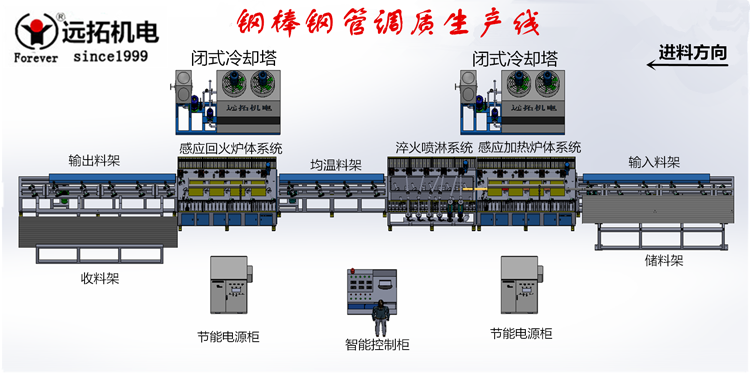
1) Why induction for bar Q&T
  • Fast, controllable heating with frequency/power matched to diameter and steel grade.
  • Closed-loop temperature control using IR pyrometers and PLC.
  • Compact footprint & recipe repeatability for multi-spec production.
2) Core equipment/modules in a bar Q&T line
  • Induction Power Supply & Coils:Medium-frequency IGBT/thyristor sources (~0.5–10 kHz for quench; temper varies). Quick-change coil sets, water-cooled copper.
  • Infeed & Conveying:Powered rollers, pinch/drive rolls, straighteners; synchronized speeds with encoder feedback.
  • Temperature Measurement (IR Pyrometers):Pre-quench and post-temper temperature feedback to PLC.
  • Spray Quench System:Annular/multi-ring headers; adjustable flow & pressure; water or PAG polymer.
  • Quench Medium Recirculation & Cooling:Tanks, pumps, heat exchangers/cooling towers, filtration.
  • Tempering Section (Induction):Reheat to tempering temperature, controlled cool-down.
  • Electrical & Control:MCC/transformer, PLC+HMI, recipes, alarms, interlocks, data logging.
3) Typical process flow

Loading → Pre-straightening → Induction Heating (austenitizing) → Spray Quench → Rinse → Induction Temper → Air/Water Cool → Straightness/Hardness Checks → Sorting/Packaging

Key control points: austenitizing temperature & effective soak, quench flow/pressure profile per diameter, tempering stabilization.

4) Common sizing ranges (engineering windows)
  • Bar diameter: ~Ø16–Ø120 mm (other ranges by design).
  • Throughput: depends on grade, diameter, hardness targets, inlet conditions.
  • Power levels: quench from hundreds of kW up to multi-MW for large bars; temper lower.
  • Frequencies: medium frequency for quench; temper frequency per thickness uniformity.

Note: Final values are engineered after confirming sizes, grades, hardness/case depth, distortion limits, and takt time.
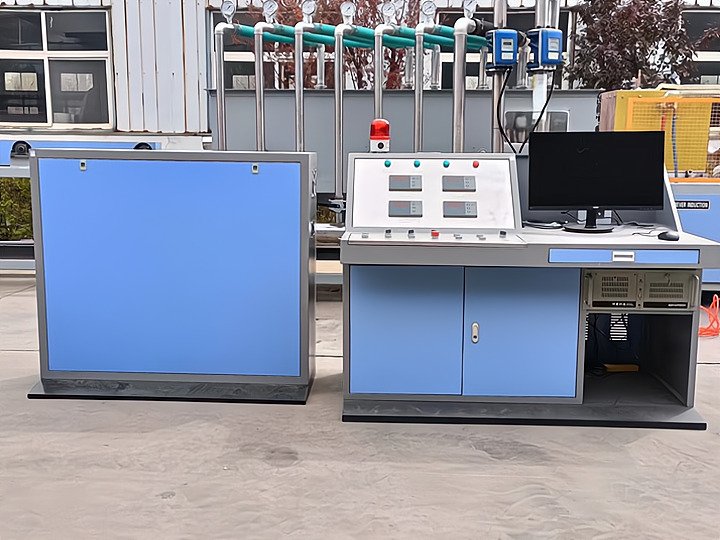
5) Quality control & documentation
  • Hardness & case depth sampling per batch/shift.
  • Straightness checks after quench and temper.
  • Record temperatures, powers, speeds, quench flow/pressure, alarms.

Yuantuo’s induction Q&T line, under PLC supervision, delivers controllable heating, engineered quenching, and precise tempering to achieve stable performance and reliable throughput.
