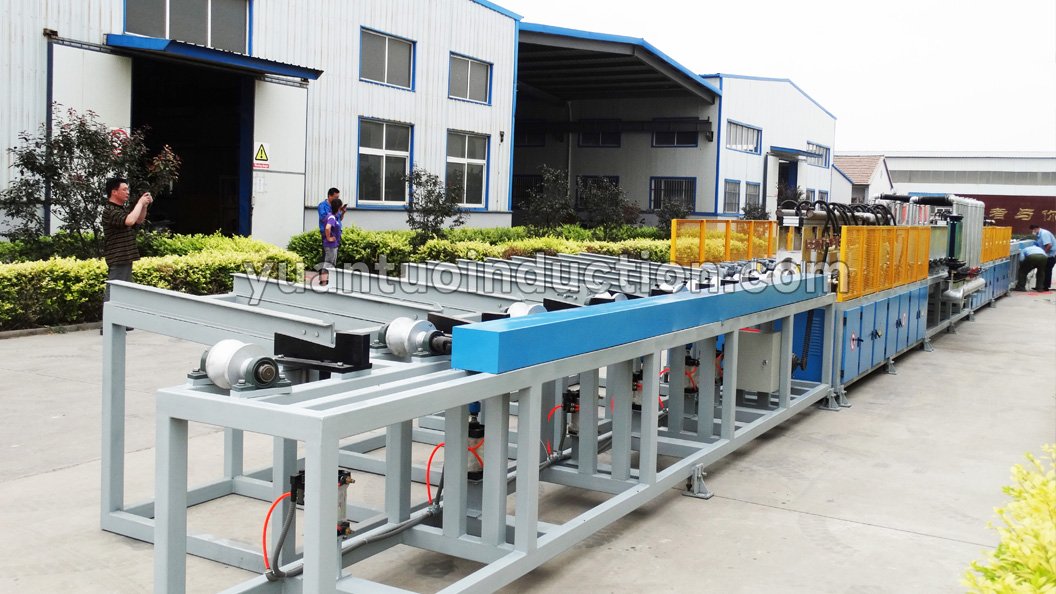
Inclined U-shaped rotary rollers are core conveying components for continuous induction quenching and tempering production of steel bars with diameter ranging from φ40 to φ105 mm. Conveying systems not only handle material transportation, but also exert a decisive impact on final heat treatment quality. If steel bars are delivered in a fixed posture through heating and quenching stations with conventional linear conveying, problems such as excessive circumferential temperature difference, uneven hardness and bar bending will inevitably occur. This production line is equipped with inclined U-shaped rotary rollers combined with feed roller tables and variable-speed idler rollers. The structure enables steel bars to rotate continuously while moving forward, fundamentally solving common quality defects in heat treatment.
Why Rotary Conveying Is Mandatory for Heat Treated Steel Bars
When steel bars pass through induction heating and spray quenching sections in a static state, two major technical issues will arise.
First,
non-uniform circumferential temperature. The magnetic field of induction coils has uneven distribution. One side of the steel bar is constantly exposed to high-intensity heating, which easily causes local overheating and even overburning. Uneven temperature further leads to inconsistent quenching effect, resulting in excessive hardness deviation around the bar circumference and failure to meet technical specifications.
Second, poor straightness. The processed steel bars have a length of 3–12.3 m. Metal plasticity increases after heating. Asymmetric thermal stress generated by one-sided heating and cooling will bend long steel bars seriously. This is a prevalent pain point for bar processing plants, which raises reject rate and requires additional straightening procedures.
Working Principle of Inclined U-shaped Rotary Rollers
Feed roller tables and intermediate conveying racks of the line adopt variable-speed idler rollers and inclined U-shaped roller assemblies. The U-shaped profile firmly supports steel bars of φ40–φ105 mm and prevents material deviation during operation. Installed at an inclined angle, the rollers rely on surface friction to drive the steel bars to perform two synchronous motions: axial forward movement and continuous circumferential rotation, realizing the working mode of forward movement with simultaneous rotation.
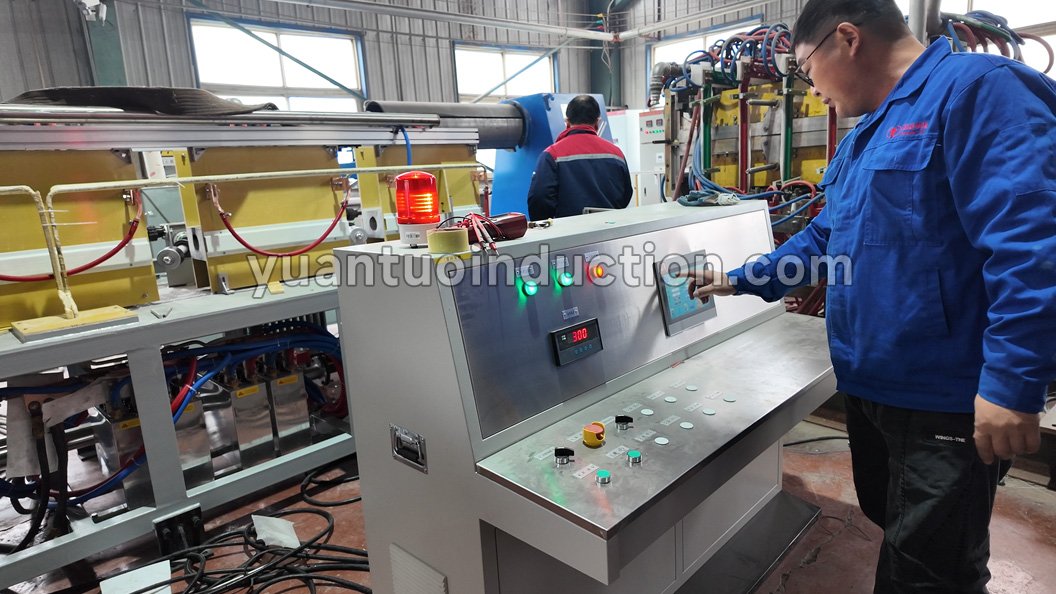
The entire conveying system is linked to the PLC control system. The running speed of variable-speed idler rollers can be adjusted flexibly according to bar specifications and production cycle, so as to match the advancing speed and rotating speed accurately. The system maintains stable rotation without jamming to adapt to full-line continuous production.
Resolve Production Defects via Rotary Conveying
With steady rotation, all circumferential parts of the steel bar alternately pass through induction heating zones and spray quenching zones. Heating temperature is stably maintained within 800–950 °C for quenching and 500–700 °C for tempering. Uniform heating and cooling completely avoid local overburning and significantly improve circumferential hardness consistency.
Meanwhile, circumferential rotation balances thermal stress across the bar section, effectively restraining bending deformation of long workpieces and guaranteeing finished product straightness. This conveying structure is compatible with four sets of dedicated furnace bodies for different diameter ranges. It requires no frequent tooling replacement and reduces commissioning time during product changeover.
Conclusion
The inclined U-shaped rotary roller conveying system delivers three core values for steel bar quenching and tempering production:
- Balance circumferential temperature distribution and prevent local overburning to stabilize heating performance;
- Achieve consistent quenching effect and uniform circumferential hardness to improve mechanical properties of finished bars;
- Offset asymmetric thermal stress and control deformation, ensuring qualified straightness of long steel bars.
As an essential part of the overall production line, this rotary conveying structure cooperates with induction heating and spray quenching systems to support high-quality and high-efficiency steel bar heat treatment.