

| Bar diameter | Quenching temperature | Calculated power demand |
|---|---|---|
| φ40 mm | 950°C | 1690 kW |
| φ60 mm | 950°C | 1680 kW |
| φ80 mm | 950°C | 1675 kW |
| φ105 mm | 950°C | 1650 kW |
Power demand decreases slightly as diameter increases. The reason: larger bars have more metal mass per unit length, but the line speed is reduced, allowing longer heating time. Thus, total power demand does not rise significantly.
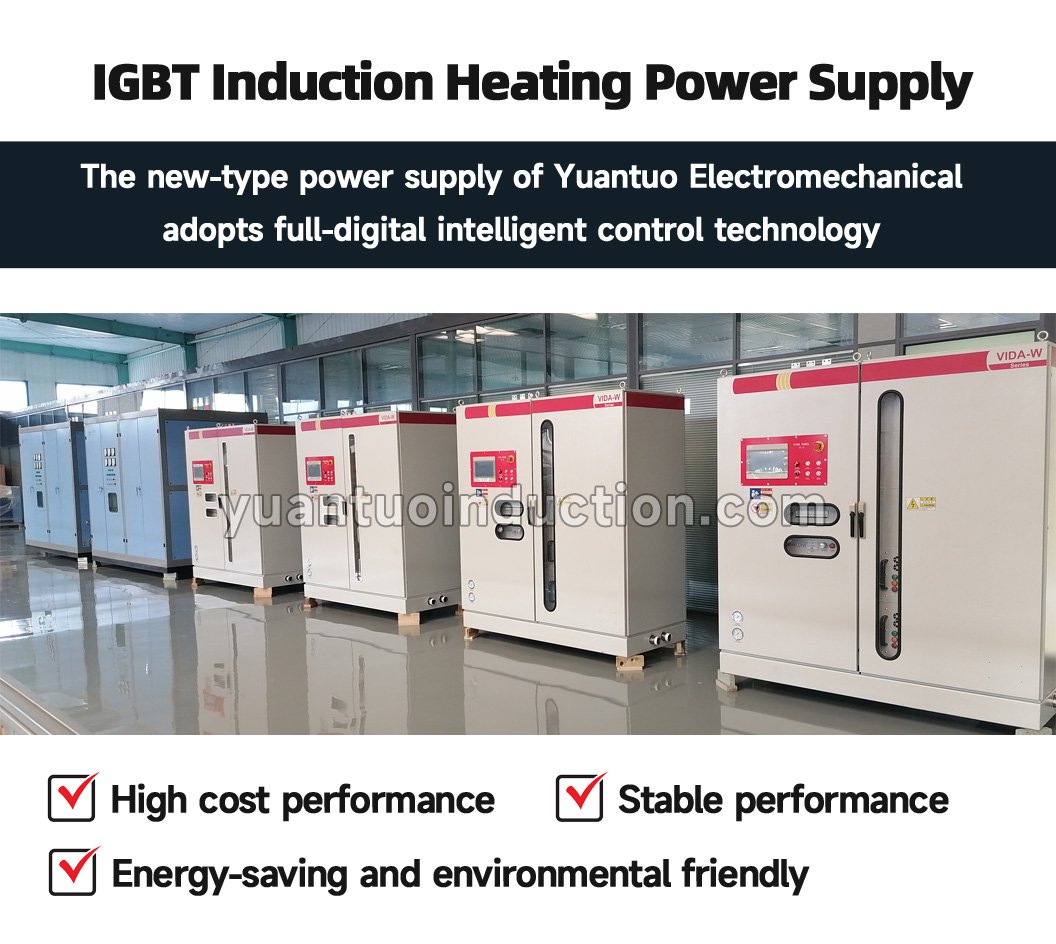
The key to a compatible line is sufficient total installed capacity + flexible power distribution – not blindly adding power. For example, the quenching section in the technical document is equipped with 800kW + 600kW + 400kW IGBT power supplies, which can be combined for different diameters.
3. Coil segmentation: gap between coil and bar determines heating efficiency
This is often overlooked but critical.
The induction heating coil must maintain a reasonable gap (typically 2‑5 mm) to the bar. Too small a gap risks scratching or jamming; too large a gap drastically reduces heating efficiency.
Using a φ50 mm coil to heat φ40 mm bars – the gap is slightly large but acceptable.
Using the same φ50 mm coil to heat φ105 mm bars – impossible because the bar cannot even pass through.
Therefore, a line covering φ40‑105 mm must have multiple coils for different diameter ranges. The technical document specifies four coil segments:
| Segment | Bar diameter range |
|---|---|
| 1 | φ40‑50 mm |
| 2 | φ55‑65 mm |
| 3 | φ70‑85 mm |
| 4 | φ90‑105 mm |
Both quenching and tempering sections have four coils each. During production, the appropriate coil is selected based on bar diameter.
4. Summary: three mandatory requirements for a 40‑105 mm compatible line
If you are considering a steel bar quenching and tempering line that can process both φ40‑105 mm bars, ensure the equipment meets these three requirements:
Multi-frequency power supply – covering at least 500 Hz to 2500 Hz, switchable or adjustable.
Multi-range coils – at least 3‑4 different diameter coil sets.
Sufficient total power and flexible power distribution – quenching section should have at least 1800 kW total capacity, with the ability to combine power sources.
Only with these three can your line truly handle both small and large bars without frequent adjustments or line changeovers.
Yuanto Machinery designs its steel bar quenching and tempering lines based on the logic above: multiple IGBT power supplies (800kW/1000Hz, 600kW/1500Hz, 400kW/2000Hz, etc.), four coil segments for quenching and four for tempering, PLC integrated control, and support for 20 stored process parameters. Whether you process 42CrMo, 45# steel, or bearing steel, with diameters from 40 to 105 mm, continuous and stable tempering is achievable.
If you are selecting or upgrading a steel bar quenching and tempering line, please provide your diameter range, material grade, and target hourly output. We can quickly recommend the appropriate frequency and coil configuration.
Website:yuantuoinduction.com
WhatsApp:+86-15226757228
Email:yuantuo38@gmail.com
