
Quenching water is not the only factor — heating uniformity, bar support, movement and tempering can also affect final straightness
In continuous steel bar heat treatment, a common production problem is:
The bar is relatively straight before heat treatment, but bending appears after quenching.
The first reaction is often to check the quenching system:
Is one side receiving more cooling water than the other?
Uneven spray cooling can certainly contribute to distortion. However, in continuous heat treatment of long steel bars, bending may develop from several stages of the process.
A better troubleshooting approach is to examine the complete sequence:
Heating → Conveying → Quenching → Tempering
rather than adjusting the quenching water first.
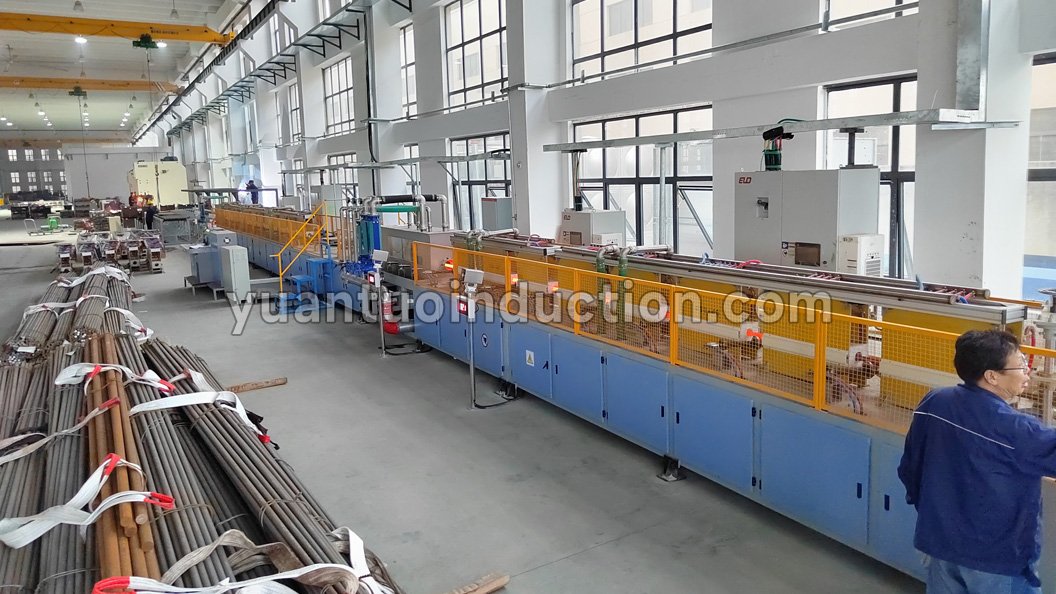
Before a steel bar enters the quenching section, its thermal condition should already be sufficiently stable for the required process.
Potential problems include:
If different areas of the bar enter the quenching section under different thermal conditions, their cooling and transformation behavior may also differ.
Therefore, when investigating bending after quenching, one of the first questions should be:
Was the steel bar uniformly heated before it entered the quenching section?
This is why stable induction heating, consistent material movement and appropriate temperature monitoring are important parts of a continuous Q&T line.

A long steel bar behaves differently at elevated temperature than it does at room temperature.
As the bar continuously passes through:
Induction Heating → Quenching → Tempering
its support and movement need to remain stable.
Depending on the workpiece and process, the conveying system may need to consider:
For long workpieces, the question is not simply:
“Can the conveyor move the bar through the line?”
The more important question is:
“Can the bar maintain a stable position and movement condition throughout the heat treatment process?”
For this reason:
Conveying is part of the heat treatment process.
It should not be treated as a mechanical accessory completely independent of heating and quenching.
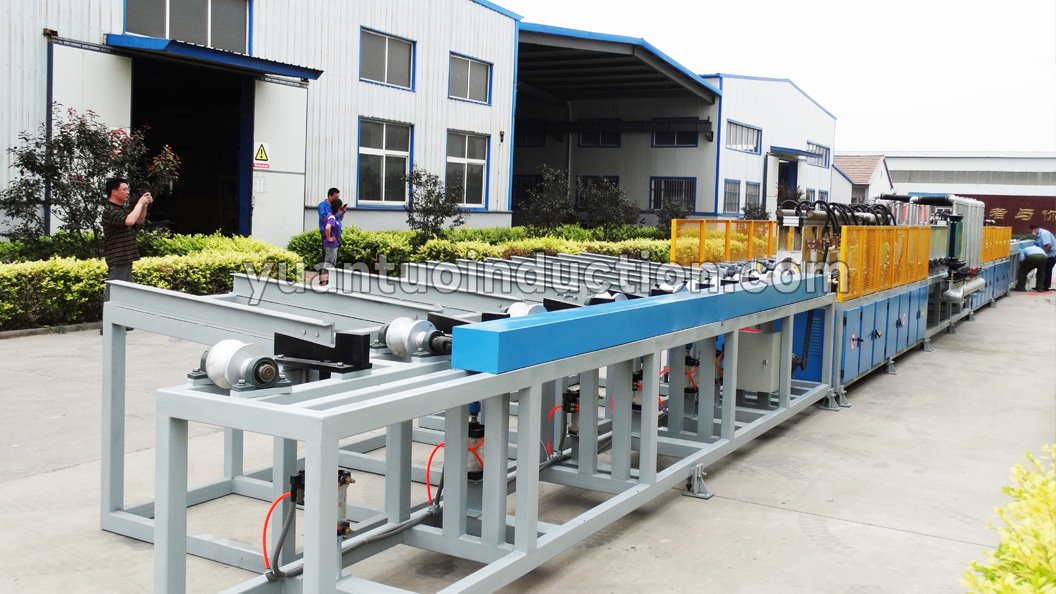
When a hot steel bar enters the quenching section, significantly different cooling conditions around its circumference can create an uneven thermal response.
The quenching system therefore needs to consider the relationship between:
Spray Position + Water Distribution + Workpiece Movement + Quenching Length
rather than focusing only on total water flow or pressure.
Another important point in continuous production is:
Does every bar pass through the quenching section in the same position and under the same movement conditions?
If the bar position changes from one workpiece to another, the actual cooling condition can change even when the spray settings remain unchanged.
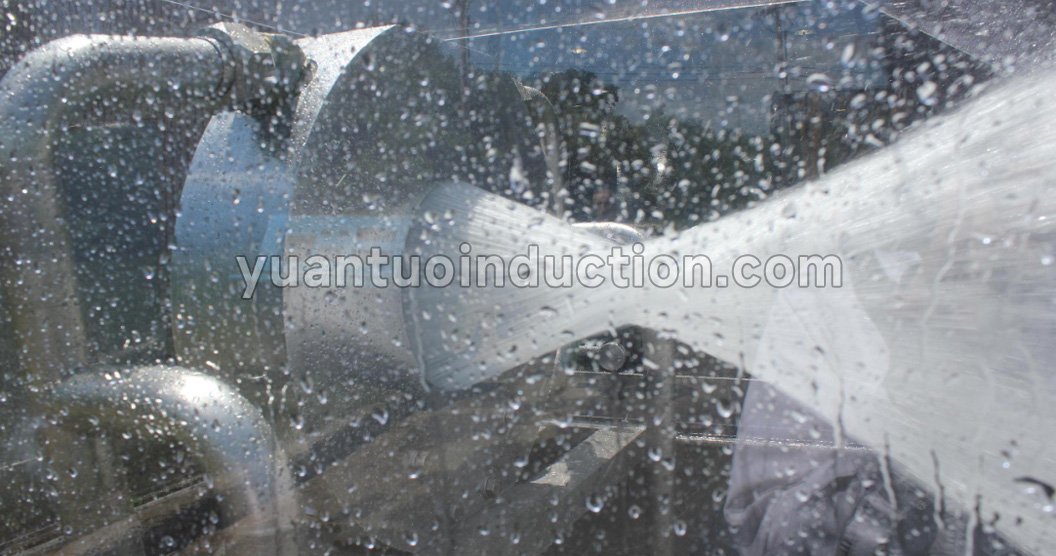
For a quenching and tempering line, heat treatment does not end when quenching is completed.
A typical process continues through:
Quenching Heating
↓
Quenching
↓
Tempering Heating
↓
Cooling
The condition of the bar after quenching, together with tempering temperature, heating uniformity and material movement, can affect the final state of the product.
Therefore, a more useful troubleshooting sequence for steel bar bending is:
Heating Uniformity
↓
Bar Position / Support / Rotation
↓
Quenching Uniformity
↓
Tempering Condition
↓
Final Straightness
rather than:
Bending Found → Immediately Adjust Quenching Water
If final straightness is an important quality requirement, it should be considered during the initial production-line design.
Useful project information includes:
| Parameter | Required Information |
|---|---|
| Bar Diameter | Minimum, maximum and main sizes |
| Bar Length | Minimum, maximum and typical length |
| Material Grade | Carbon steel, alloy steel, etc. |
| Heat Treatment | Quenching, Q&T, etc. |
| Target Properties | Hardness / mechanical properties |
| Required Capacity | t/h or pcs/h |
| Initial Straightness | Condition before heat treatment |
| Final Straightness | Required after heat treatment |
For long bars, workpiece length should be provided at an early stage of the project.
Length affects not only the overall equipment layout, but also:
Loading + Supporting + Conveying + Process Transfer + Discharge
No. Uneven quenching can be one cause, but heating uniformity, bar position, conveying support, movement conditions and tempering should also be checked.
Not by itself. Rotation can be one engineering method for improving circumferential heating or cooling consistency, but it must be matched with the heating, supporting, conveying and quenching systems.
Longer bars require appropriate support and stable conveying through different process sections. Length therefore affects both the mechanical layout and the stability of the continuous heat treatment process.
For a steel bar quenching and tempering project, useful information for an initial engineering evaluation includes:
Diameter + Length + Material Grade + Required Hardness / Mechanical Properties + Capacity + Straightness Requirement
For long steel bars, Yuantuo Induction evaluates the complete process around:
Heating + Supporting + Conveying + Rotation + Quenching + Tempering
rather than treating post-quenching bending as a problem caused by one spray parameter alone.
The objective is to maintain stable workpiece conditions throughout the continuous heat treatment process and achieve repeatable final product quality.
WhatsApp:+86 15226757228
Email:yuantuo38@gmail.com
Website:www.yuantuoinduction.com
