
In consultations regarding sucker rod quenching equipment, client concerns are typically quite specific: Does the loading and unloading process require manual intervention? Is it possible to avoid heating the threaded sections? And can the rod ends be subjected to targeted, concentrated heating? While these may appear to be merely localized functional issues, they are, in reality, inextricably linked to the overall automation configuration and induction heating control capabilities of the entire quenching system.

Let’s begin with loading and unloading. Whether a sucker rod project necessitates manual loading and unloading depends primarily on the client’s production capacity requirements, automation budget, and on-site management protocols. For projects with less stringent cycle time requirements, a relatively simplified configuration may suffice; however, for projects demanding continuous production and higher operational stability, the system can be equipped with automated loading, conveying, positioning, and unloading mechanisms to minimize manual intervention and enhance operational consistency. Sucker rod quenching equipment need not be solely reliant on manual operation; the critical factor is whether the project solution was designed with an automation-centric mindset from the very outset.
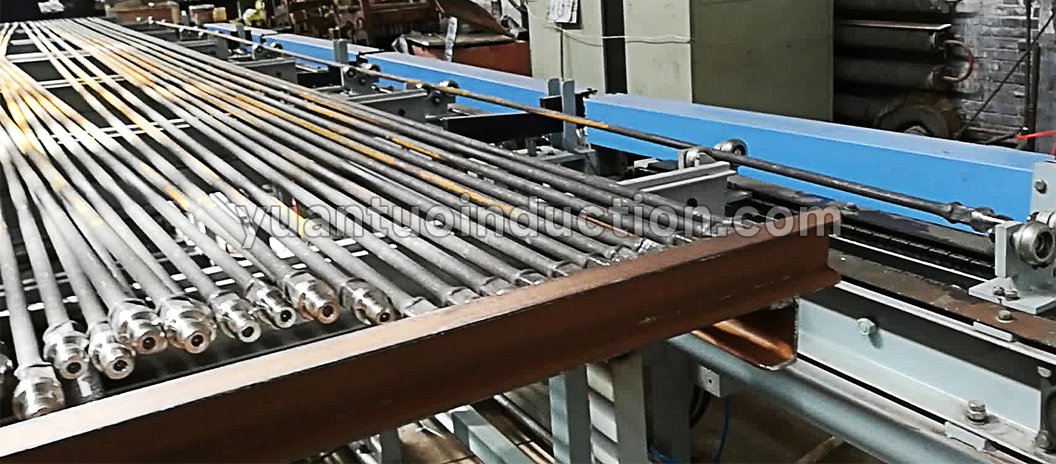
Regarding the ability to avoid heating the threaded sections—this constitutes a highly typical process requirement for sucker rod-type workpieces. Threaded areas typically entail specific demands regarding dimensional precision and functional performance; consequently, many projects require that these sections be excluded from the simultaneous heating of the main rod body. Achieving this objective necessitates a comprehensive design approach that integrates workpiece positioning strategies, the effective heating zone of the induction coil, shielding techniques, and programmable controls—rather than relying on simple manual visual inspection. A truly sophisticated sucker rod quenching system should be capable of tailoring its operation to the client’s specific process requirements, applying targeted treatment to—or deliberately avoiding—designated areas of the workpiece.
As for the feasibility of applying concentrated heating to the rod ends, the answer is typically affirmative; however, the specific implementation method is contingent upon the end structure, required heating length, production cycle time, and temperature control precision. Concentrated end heating is not merely a matter of “boosting the power output”; rather, it requires a coordinated interplay between localized heating coil matching, workpiece positioning, and control programming to ensure the rod ends attain the requisite temperature while avoiding any adverse impact on adjacent sections.For projects with more stringent requirements, cooling strategies must be incorporated into the design process to ensure effective thermal management.
Hebei Yuantuo offers customized solutions for sucker rod quenching equipment, tailored to specific rod specifications, threading requirements, designated heating zones, and production line cycle times. Our professional engineers provide personalized, one-on-one consultation services—including complimentary design proposals—and can furnish video footage of the equipment in actual operation to help clients gain a clearer understanding of the practical system configuration and performance capabilities.
