
The core task of a steel bar quenching and tempering line is to continuously quench and temper round bars or steel bars to achieve the required hardness, strength, and toughness. A complete steel bar quenching and tempering line typically consists of five main stages: loading, induction quenching, spray cooling, induction tempering, cooling and collection. Based on actual engineering configurations for φ40‑105 mm steel bar lines, this article explains the function and coordination of each stage.

Process nodes: Overhead crane → Storage platform → Automatic bar feeder → Infeed roller table
Function:
Transport bars from stockyard to the storage platform, creating a buffer.
An automatic bar feeder sends bars one by one to the infeed roller table, maintaining continuous production rhythm.
The infeed roller table uses variable frequency drive to adjust speed according to bar diameter and heating requirements, thus controlling heating time.
Key point: The loading rhythm must match the capacity of the quenching section to avoid starving or piling.
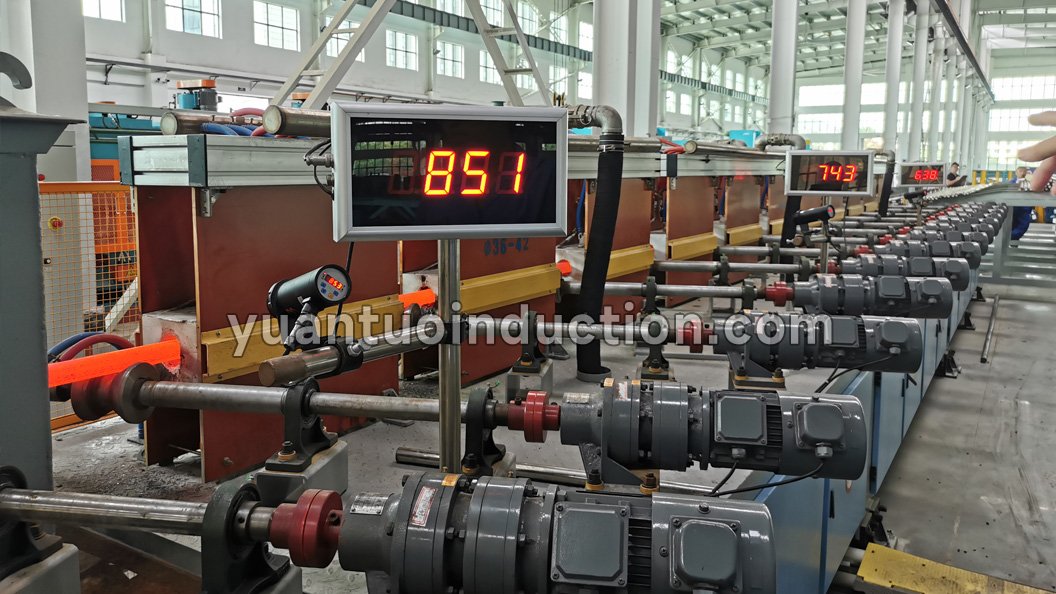
Process nodes: Induction quenching heating → Infrared temperature measurement
Function:
Bars pass through induction heating coils and are rapidly heated to quenching temperature (typically 800‑950°C) under the alternating magnetic field.
For a diameter range of φ40‑105 mm, multi‑frequency and multi‑power IGBT power supplies (e.g., 800kW/1000Hz, 600kW/1500Hz, 400kW/2000Hz) and multiple coil sizes are required to ensure proper heating depth and temperature uniformity for different diameters.
An infrared temperature system measures surface temperature in real time and feeds back to the PLC, which adjusts power or speed to maintain stable quenching temperature.
Key point: Controlling core‑to‑surface temperature difference is critical. Frequency selection directly affects heating penetration depth.
Process nodes: Quenching spray (tank + spray rings) → Transfer roller table
Function:
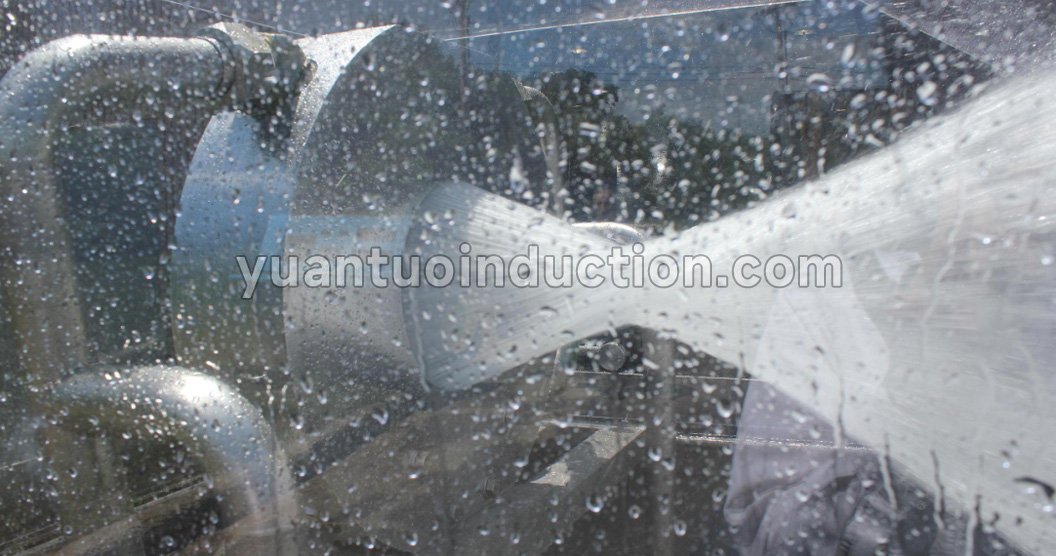
Bars at quenching temperature immediately enter the spray zone and are rapidly cooled by high‑flow water, transforming austenite into martensite or bainite.
The quench tank is equipped with stainless steel spray rings and sensors for water pressure, temperature, and flow (e.g., 0.3 MPa, ≤45°C, 500 m³/h).
Cooling uniformity is essential for consistent hardness. Spray rings must be free of clogging and water pressure evenly distributed.
Key point: Insufficient or uneven cooling directly leads to low hardness or soft spots.
Process nodes: Transfer roller table → Induction tempering heating → Infrared temperature measurement
Function:
After quenching, bars are conveyed to the induction tempering section and heated to tempering temperature (typically 500‑700°C) to relieve quenching stress, adjust toughness, and stabilize microstructure.
The tempering section also uses multiple IGBT power supplies (e.g., 600kW/1000Hz, 400kW/1500Hz) and multiple coil sizes matching the quenching section.
Infrared temperature measurement works with the PLC to maintain stable tempering temperature, avoiding over‑tempering or under‑tempering.
Key point: Tempering heating must be closely synchronized with post‑quench transport rhythm to prevent excessive cooling of bars during intermediate waiting.
Process nodes: Roller table/cooling rack → Collection rack
Function:
After tempering, bars are air‑cooled (or forced‑air cooled) on the cooling rack to a temperature safe for handling.
The collection rack gathers finished bars in rows for subsequent bundling, unloading, and storage.
Key point: The length of the cooling rack and the collection rhythm must match the upstream production speed to avoid surface damage from pile‑up.
The five stages above are not independent; they are linked by a PLC main control console. The PLC system:
Receives infrared temperature signals and adjusts power supply output and variable‑frequency roller speed.
Stores up to 20 process parameter sets, allowing quick changeover based on bar diameter and material.
Records production data (temperature, power, speed, etc.) for quality traceability.
Summary: A typical complete steel bar quenching and tempering line process can be summarized as: Loading → Induction quenching → Spray cooling → Induction tempering → Cooling and collection. Parameter settings and coordination of each stage directly affect final hardness, microstructure, and property stability. For large diameter spans like φ40‑105 mm, multi‑frequency power supplies, multiple coil sizes, and PLC closed‑loop control are essential for continuous and efficient operation.
Yuanto Machinery’s steel bar quenching and tempering lines strictly follow the above process, equipped with intelligent IGBT power supplies, four‑step quenching/tempering coils, infrared temperature measurement, and PLC line control. For a process flow diagram or technical proposal based on your bar parameters (diameter, material, output), please contact us.
Website:yuantuoinduction.com
WhatsApp:+86-15226757228
Email:yuantuo38@gmail.com
