
In many sectors such as construction steel, engineering machinery and mining equipment, round bars with diameters between 25 and 300 mm are widely used for critical components that must withstand high loads and demanding service conditions.
To meet these requirements, Hebei Yuantuo Electromechanical Equipment Manufacturing Co., Ltd. has developed a customized induction quenching and tempering line for steel bars, providing reliable solutions for both full-section and local surface heat treatment.
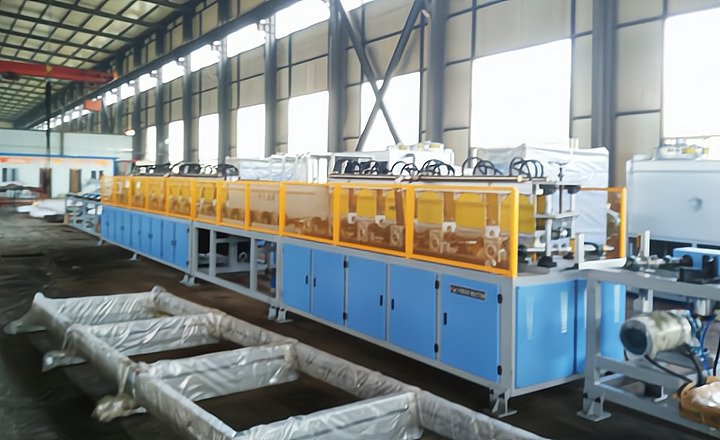
Because round bars cover a wide range of diameters and steel grades, a “one-size-fits-all” induction coil cannot guarantee uniform temperature and consistent mechanical properties.
Yuantuo’s steel bar heat treatment line is a non-standard, custom-engineered system. Based on the characteristics of medium-frequency induction heating, each bar diameter is matched with a dedicated inductor and furnace body. The line generally adopts single-station continuous in-line heating, ensuring stable temperature control and repeatable process quality.
The heating furnace bodies are designed for quick changeover. When the product size changes, the operator only needs to replace the corresponding furnace body, without major modifications to the entire line. This significantly shortens changeover time and increases production flexibility.
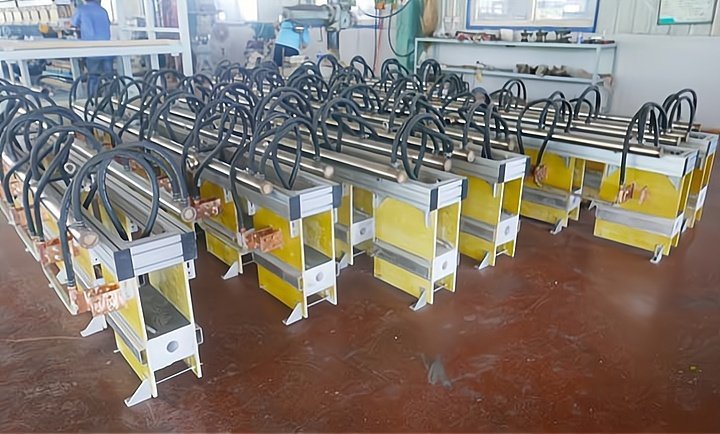
To achieve the desired heating efficiency and metallurgical quality, Yuantuo designs each line according to the customer’s specific process requirements, focusing on the following parameters:
For larger diameters, a higher power, lower frequency medium-frequency power supply is recommended.
For smaller diameters, a lower power, higher frequency configuration is more suitable.
For full-section heating or deep case / large heating area, the system is configured with higher power and relatively lower frequency.
For local surface heating or shallow case depth, a higher frequency and relatively lower power are used to concentrate energy in the required zone.
3. Required Heating Speed and Line Throughput
When the customer targets a higher production rate and shorter heating time, Yuantuo increases the installed power and optimizes the frequency combination, ensuring both productivity and uniform temperature distribution.
4. Continuous Operating Time
For lines that must run continuously over long shifts, the design includes power reserve margin, enhanced cooling, and robust components to ensure reliable and stable operation.
5. Distance Between Power Supply and Inductor
When the inductor is installed far from the power cabinet and water-cooled cables are required, Yuantuo considers line losses and compensation in the design, and selects an appropriately higher power rating to maintain effective heating performance.

System Configuration of the Steel Bar Heat Treatment Line

A complete Yuantuo steel bar quenching and tempering line typically consists of:
Inlet and outlet storage racks
Inlet and outlet conveying systems
Self-rotating roller table for bar transport
Medium-frequency quenching heating module
Medium-frequency quenching holding module
Medium-frequency tempering module
Medium-frequency annealing module (optional, according to process)
Spray quenching system
Hydraulic station and auxiliary mechanisms
Central control console
Automatic control system (PLC / industrial PC)
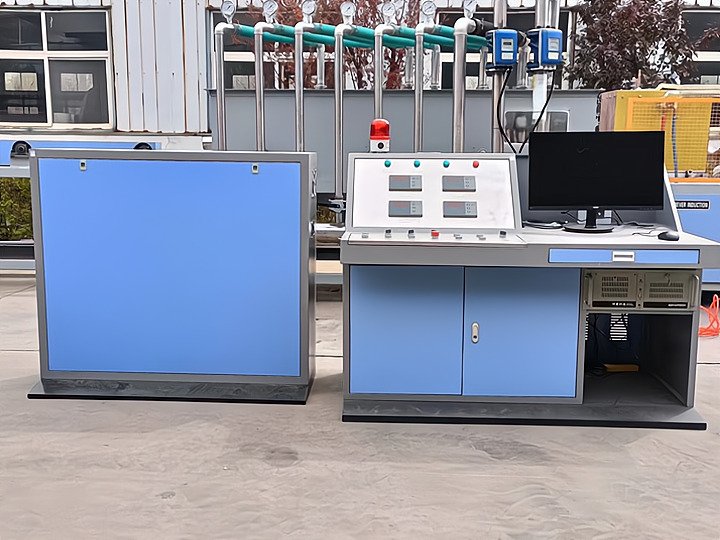
By combining these modules, the line can be configured for different process routes such as quenching + tempering or quenching + tempering + annealing, depending on the target properties.
Typical Process Flow
Operators manually place the bars from the material box onto an inclined roller rack (typically 10–15 bars at a time) and arrange them neatly.
The bars then roll into the inlet chute and are pushed into the induction furnace by a pneumatic pusher according to the preset cycle. After being heated to the required quenching temperature at the outlet side of the furnace, the bars move via chute or roller table directly into the spray quenching station.
Subsequently, the bars enter the tempering (and, if required, annealing) modules to complete the full quenching and tempering process and achieve the specified mechanical properties.
Main Advantages of Yuantuo’s Steel Bar Heat Treatment Line
Compared with traditional flame heating or conventional furnace processes, Yuantuo’s induction quenching and tempering line for steel bars offers several key advantages:
1.Shorter Heat Treatment Cycle and Better Working Conditions
Induction heating provides fast heating rates and a high level of automation. This shortens the overall heat treatment cycle and reduces manual handling in high-temperature areas.
2. Improved Production Organization and Product Consistency
A continuous, rhythm-based production mode helps optimize plant scheduling. Combined with temperature measurement and PLC closed-loop control, the line improves consistency in hardness, strength and toughness.
3. Material Savings and Longer Die Life
With precisely controlled heating zones and reduced surface burning and oxidation, material utilization is improved. At the same time, more stable heating conditions help extend the service life of forging dies and tooling.
4. Cleaner Shop Environment
Induction heating does not produce open flames or heavy smoke and dust. This contributes to a cleaner workshop and supports environmental and occupational health requirements.
5. High Efficiency and Energy Performance
Short heating times and high thermal efficiency allow the line to meet modern steel and machinery producers’ dual requirements of high output and reduced energy consumption.
For steel producers and forging companies seeking to upgrade bar heat treatment processes, Yuantuo can provide customized induction solutions based on actual bar sizes, steel grades and production targets.
