
Pipe OD, wall thickness, material grade, frequency, heating time and line speed all affect temperature distribution through the pipe wall.
In continuous steel pipe induction heat treatment projects, one of the first parameters operators monitor is:
What is the pipe temperature at the heating outlet?
If an infrared pyrometer shows that the outer surface has reached the target temperature, it may seem reasonable to conclude:
“The pipe has reached the required temperature and is ready for quenching.”
For steel pipes, especially thick-wall pipes, this conclusion may be incomplete.
The reason is simple:
An infrared pyrometer normally measures the surface temperature, while the heat treatment process depends on the thermal condition through the pipe wall.
A possible situation is:
Outer surface reaches the target temperature → Inner wall remains at a lower temperature → Temperature condition through the wall is not uniform → The pipe enters quenching with an unsuitable thermal distribution → Final microstructure or mechanical properties may vary
Therefore, continuous pipe heat treatment should not answer only:
“What is the outer surface temperature?”
It should also consider:
“At the current line speed, has the complete pipe wall reached the thermal condition required by the heat treatment process?”
These are two different questions.

A steel pipe is different from a solid round bar.
Its geometry is determined by three related parameters:
Outer Diameter + Inner Diameter + Wall Thickness
Consider two pipes with the same outer diameter.
OD: Ø100 mm
Wall thickness: 5 mm
OD: Ø100 mm
Wall thickness: 20 mm
Although the outside diameter is identical, the amount of metal per unit length and the thermal conditions through the wall are very different.
This means:
Pipe OD alone is not enough to determine the induction heating configuration.
For thick-wall pipes, engineers need to pay particular attention to:
This is why wall thickness should always be one of the basic parameters when evaluating a steel pipe heat treatment project.
When the inner wall is not sufficiently heated, a common reaction is:
“Increase the induction power.”
However, this does not automatically solve the problem.
The thermal condition of a pipe during induction heating depends on several interacting factors, including:
If power is simply increased while the available heating time remains insufficient, the outer region may heat even faster while the inner wall still does not reach the required thermal condition.
The engineering objective is therefore not:
“How can we make the outer surface reach the target temperature faster?”
It is:
“How can we achieve the required through-wall thermal condition at the target production rate?”
That distinction is critical when designing a continuous steel pipe heat treatment line.
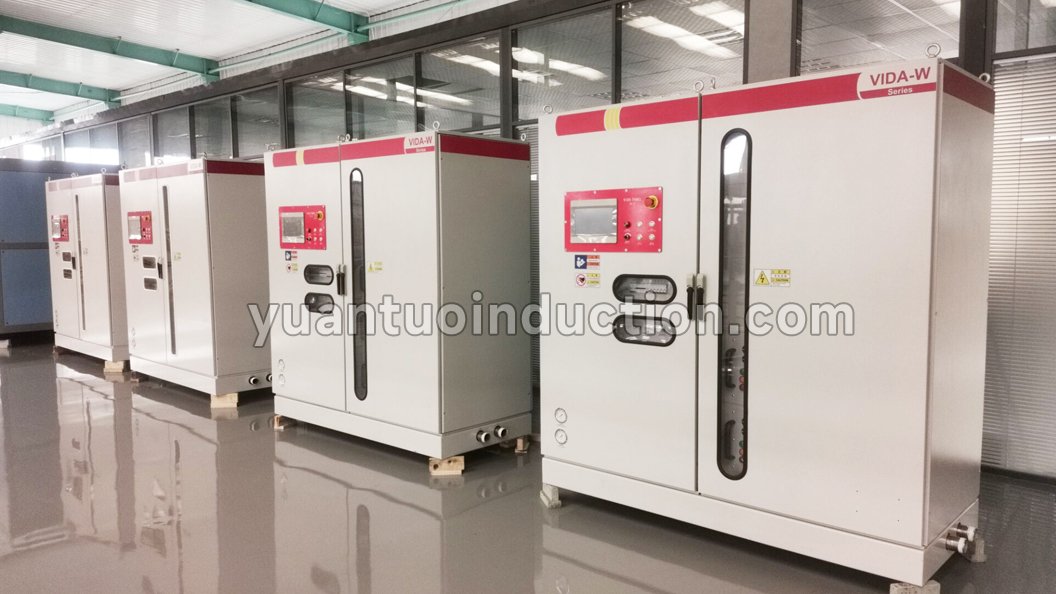
Frequency is one of the important parameters in steel pipe induction heating.
It affects how induced current is distributed in the material and therefore needs to be evaluated together with:
For a pipe that requires austenitizing before quenching, rapid surface heating alone is not the objective.
For thicker-wall pipes in particular, an unsuitable combination of frequency, power and heating time may increase the temperature difference between the outer and inner wall.
Therefore:
Higher frequency is not automatically better, and higher power is not automatically better.
The real requirement is an appropriate balance of:
Frequency + Power + Heating Time + Pipe Geometry
Suppose a manufacturer wants to increase line capacity.
One obvious approach is to increase the pipe travel speed.
However, when line speed increases, each section of the pipe spends less time inside the effective heating zone.
In simple terms:
Higher Line Speed → Shorter Effective Heating Time → Different Through-Wall Temperature Development → Potentially Larger Temperature Difference
Therefore, in continuous production:
Production capacity and temperature uniformity cannot be treated as two completely separate issues.
If the required throughput in t/h increases, the heating system may need to be re-evaluated in terms of:
Simply increasing conveyor speed is not a reliable way to increase complete-line capacity.
Temperature uniformity is not only a through-wall issue.
Circumferential consistency also matters.
If a steel pipe has:
the relative position between the pipe and the inductor may change during heating.
Depending on the pipe geometry and process requirements, the production line therefore needs to consider:
Rotation is not simply a conveying function.
Stable forward movement combined with controlled rotation can help create more consistent circumferential heating conditions and provide a more stable workpiece condition for the downstream quenching section.
This is why the mechanical conveying system should be treated as part of the heat treatment process rather than as a separate accessory.
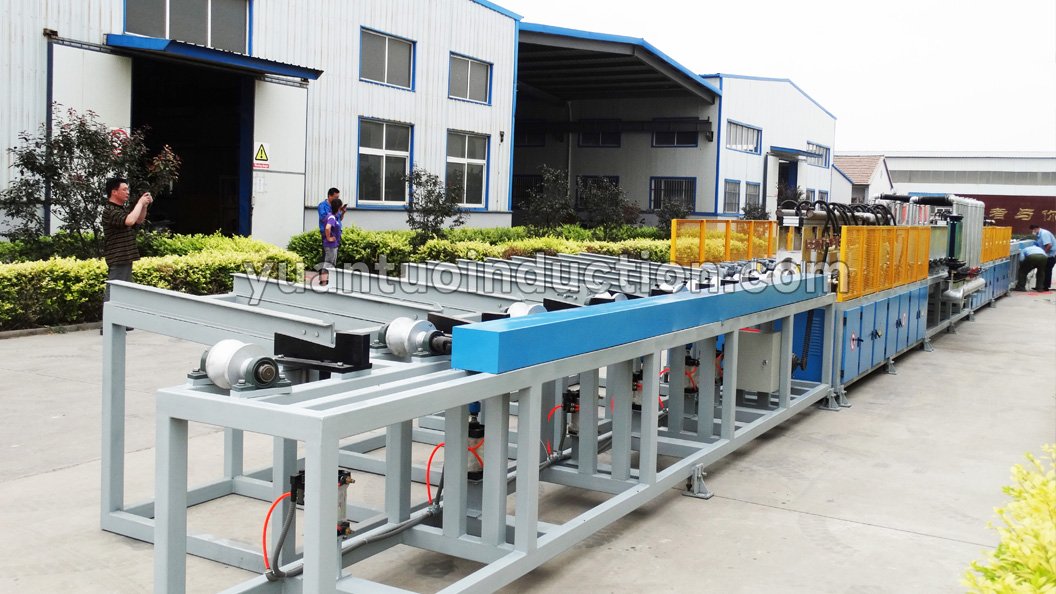
Online infrared temperature measurement is an important part of a continuous pipe heat treatment line.
However, one point must be understood:
A surface temperature measurement does not directly tell you the temperature through the entire pipe wall.
The pyrometer reading should therefore be interpreted together with:
During production, online temperature measurement can form part of a control loop:
Temperature Measurement → PLC Evaluation → Power / Speed Adjustment → More Stable Process Conditions
For a new pipe size, new material or new heat treatment requirement, however, process validation is still important.
The engineering team needs to establish whether the measured surface temperature corresponds to the required thermal condition through the wall.
This is more meaningful than simply setting one outlet temperature value and applying it to every product.
After induction heating, the pipe normally needs to enter the quenching section with controlled timing.
If the thermal condition before quenching is already inconsistent—for example, the outer wall is much hotter than the inner wall—then different parts of the pipe wall may enter the cooling stage under different thermal conditions.
Depending on the steel grade and process, this can contribute to problems such as:
Therefore, when quenching results become unstable, troubleshooting should not start and end with:
“Is the quenching water pressure sufficient?”
The upstream process should also be checked:
“Was the pipe in the correct and repeatable thermal condition before entering the quenching section?”
A quality problem detected after quenching may have started during heating.
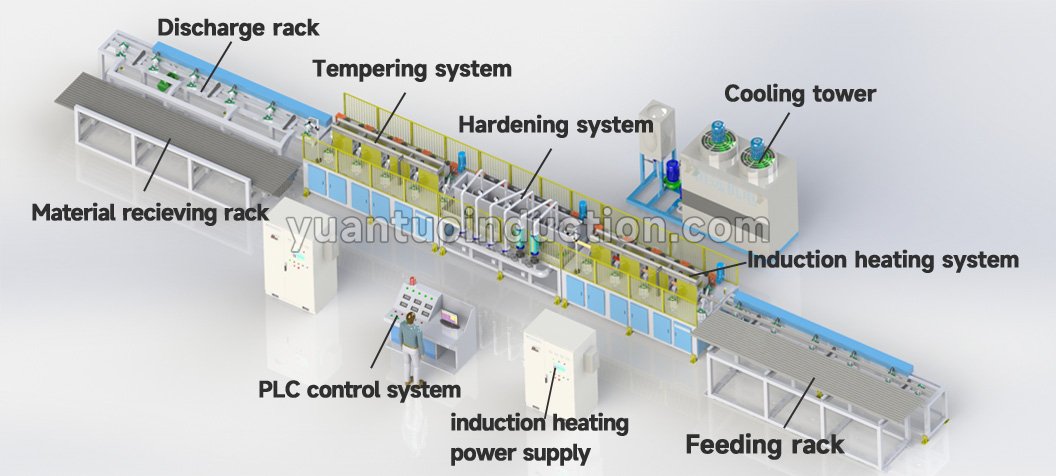
For a complete steel pipe quenching and tempering project, temperature control should be considered throughout the production line.
Confirm:
OD + Wall Thickness + Length + Material Grade
↓
Determine:
Frequency + Power + Effective Heating Length + Line Speed
↓
Consider:
Supporting + Guiding + Rotation + Centering
↓
Monitor:
Heating Outlet Temperature
↓
Match:
Entry Temperature + Spray Cooling + Line Speed
↓
Control:
Tempering Temperature + Effective Heating Time
↓
Evaluate:
Hardness + Mechanical Properties + Process Repeatability
A pipe Q&T line should therefore not be designed around one temperature measurement point alone.
The complete:
Temperature + Time + Material Movement + Cooling Process
must work together.
Internal Link: Steel Pipe Quenching and Tempering Line
As wall thickness increases, more attention generally needs to be paid to:
For this reason, two pipes with the same:
Ø100 mm OD
but different wall thicknesses—such as 5 mm and 20 mm—should not automatically be assigned the same heating configuration.
This is also why, for steel pipe heat treatment projects, Yuantuo normally needs:
OD + Wall Thickness + Length + Material + Capacity + Required Properties
rather than only:
“What is the pipe diameter?”
| Parameter | Recommended Information |
|---|---|
| Pipe OD | Minimum, maximum and main sizes |
| Wall Thickness | Minimum, maximum and typical thickness |
| Pipe Length | Minimum, maximum and typical length |
| Material Grade | Steel grade/specification |
| Heat Treatment Process | Quenching, Q&T or other process |
| Quenching Temperature | If already specified |
| Tempering Temperature | If already specified |
| Target Properties | Hardness, strength, toughness, etc. |
| Production Capacity | t/h or pipes/hour |
| Product Mix | Main OD × wall thickness combinations |
| Upstream/Downstream Equipment | Loading, straightening, inspection, etc. |
For tubing, casing, drill pipe and other products with upset ends or local section changes, drawings or workpiece photos should also be provided at the early project stage.
Local geometry changes may affect heating, conveying and overall line design.
Not based on the surface temperature alone. Wall thickness, material grade, heating time, line speed and the validated process window should also be considered to determine whether the required thermal condition has been achieved through the pipe wall.
Not necessarily. Increasing power may increase the surface heating rate without providing sufficient time for the required through-wall thermal condition. Frequency, effective heating time, heating length, line speed and power configuration should be evaluated together.
Wall thickness affects the amount of material per unit length, heating time and through-wall temperature development. Pipe OD alone is insufficient for a reliable process evaluation.
Not as a standalone rule. Required power depends on production capacity, material, target temperature, frequency, effective heating length, line speed and other process conditions.
Depending on the workpiece and process, controlled rotation can help improve circumferential heating and cooling consistency while maintaining stable pipe movement through the continuous line.
For continuous steel pipe heat treatment, reaching the target outer surface temperature does not automatically mean that the complete pipe wall has reached the required thermal condition.
This is especially important for thick-wall pipes.
A reliable engineering evaluation should consider:
Pipe OD + Wall Thickness + Material Grade + Target Temperature + Frequency + Power + Heating Time + Line Speed + Quenching Conditions
Hebei Yuantuo Electromechanical designs customized complete induction heat treatment lines around the customer’s actual workpiece range, material grades, required properties and production capacity.
The engineering scope can integrate:
induction heating, rotating conveying, online temperature monitoring, quenching, tempering, cooling and automatic line control into one coordinated production process.
For an initial technical evaluation, please provide:
Pipe OD / Wall Thickness / Length / Material Grade / Required Capacity / Target Mechanical Properties.
WhatsApp:+86 15226757228
Email:yuantuo38@gmail.com
Website:www.yuantuoinduction.com
