
Bar Diameter Is Only the Starting Point — Material Grade, Length, Mechanical Properties, Capacity and Process Takt Determine the Complete Line Configuration
When customers first contact us about a steel bar heat treatment project, they often start with information such as:
Steel bar diameter: Ø30–60 mm
Then comes the question:
“What machine do you recommend?”
For a continuous steel bar quenching and tempering project, however, diameter is only the beginning of the engineering evaluation.
Consider two projects using the same Ø30–60 mm bar range.
Project A:
Project B:
The diameter range may be identical, but the required heat treatment process and production line configuration can be very different.
For this reason, the first engineering question should not be:
“How many kW does the customer need?”
A more useful question is:
“What steel bars need to be treated, what properties must be achieved, and what production capacity is required?”
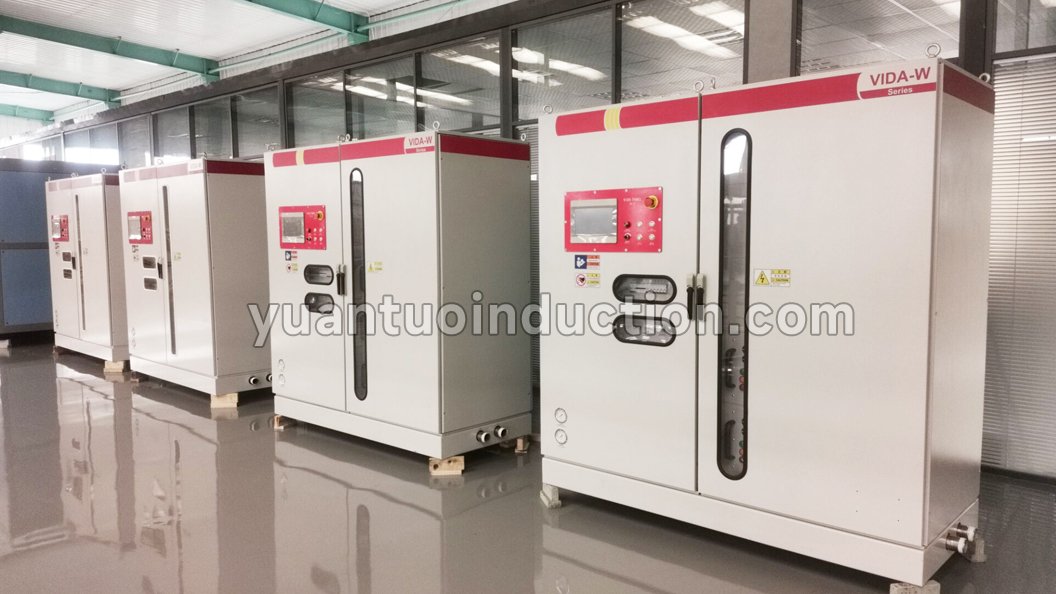
The first step in designing a customized line is to define the actual production range.
Important information includes:
One point is particularly important:
The largest bar diameter is not necessarily the most important production size.
For example, a customer may specify a production range of:
Ø20–80 mm
but 80% of annual production may actually be concentrated between:
Ø30–50 mm.
If the complete line is designed only around the maximum Ø80 mm size without considering the customer’s main production range, the resulting configuration may not provide the best operating efficiency for everyday production.
For engineering evaluation, it is therefore more useful to provide:
Complete size range + Main production sizes + Production share by size
rather than only the maximum diameter.
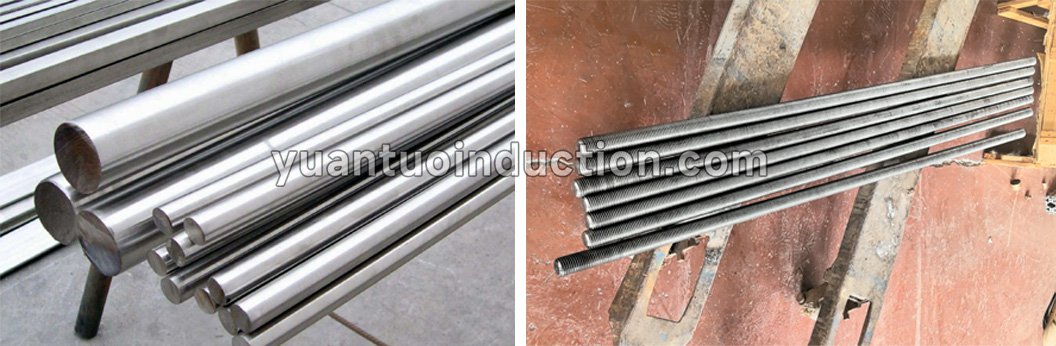
The production line must ultimately serve the required product properties.
Before determining the induction heating, quenching and tempering configuration, engineers need to understand:
For example, two 42CrMo steel bars of the same diameter may require completely different equipment configurations if one project requires a specific hardening result while the other requires a complete quenching and high-temperature tempering process.
The correct engineering sequence should therefore be:
Material Grade → Target Properties → Heat Treatment Process → Production Line Configuration
rather than:
Select Equipment First → Determine What Products It Can Process Later
This is one of the main differences between a customized heat treatment line and a standard standalone heating machine.
Once the material and heat treatment objective are clear, the induction heating section can be evaluated.
The main factors normally include:
These parameters are then used to determine the relationship between:
Power + Frequency + Inductor Design + Effective Heating Length + Number of Heating Zones
This means that induction power is not the starting point of the design.
It is one of the engineering results obtained after the process requirements have been evaluated.
For this reason, simply specifying:
“We need a 1,000 kW induction heating system.”
is usually not enough to determine whether the equipment will actually match the required production process.
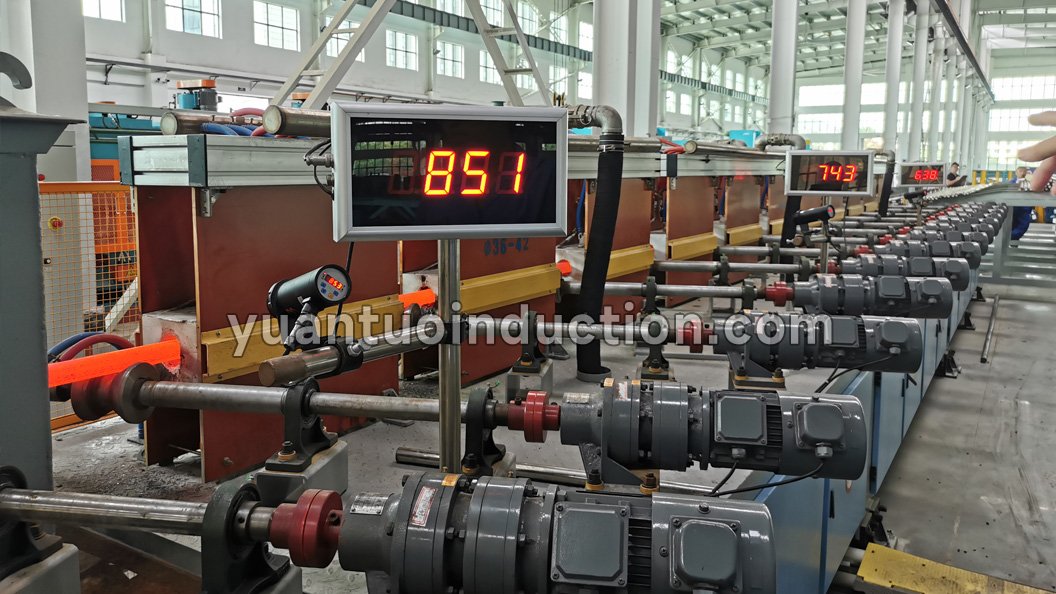
Steel bar Q&T is not simply a matter of placing a short workpiece inside an induction coil.
For bars several meters long, the workpiece must continuously pass through the complete process:
Loading → Heating → Quenching → Tempering → Cooling → Discharge
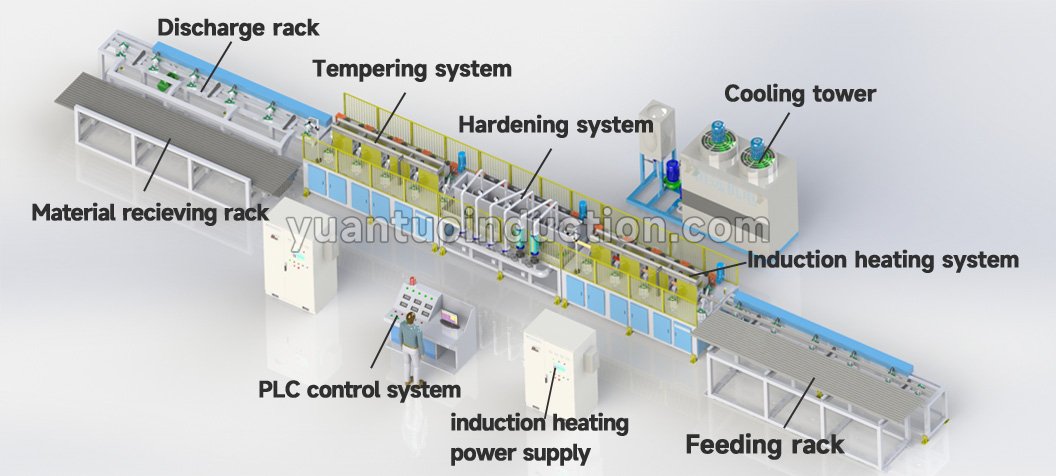
The mechanical conveying system therefore directly affects the heat treatment process.
The line design may need to consider:
For continuous induction heat treatment of round bars, rotating conveying can be incorporated according to the actual workpiece and process requirements.
Its purpose is not simply to move the bar forward. Proper movement and rotation can also contribute to more consistent circumferential heating and cooling conditions.
Therefore:
The conveying system should not be treated as an accessory to the induction heater. It is part of the complete heat treatment process.
After induction heating, the steel bar enters the quenching section according to the specified process.
At this stage, the engineering task involves much more than simply spraying water onto a hot bar.
Factors to evaluate include:
If the upstream heating section can process a high tonnage per hour but the quenching system cannot remove the required heat at the same production rate, the complete line cannot operate at its intended capacity.
Therefore:
Induction heating capacity is not the same as complete-line production capacity.
The real throughput must be determined by the entire process chain.

If the required process is Quenching & Tempering (Q&T), heat treatment does not end after quenching.
The tempering section must also be matched to the process.
Important factors include:
A complete steel bar Q&T line therefore needs to be considered as an integrated process:
Quenching Heating → Quench Cooling → Tempering Heating → Final Cooling → Discharge
The capacity of each section must support the required production takt.
Internal Link: Steel Bar Quenching and Tempering Line
A common parameter in overseas project inquiries is:
Required capacity: 5 t/h
This is an important starting point, but it should not be interpreted simply as:
“Select an induction power supply capable of heating five tons of steel per hour.”
The engineering team must evaluate the entire production chain:
Loading Capacity → Quenching Heating Capacity → Conveying Speed → Quenching Capacity → Tempering Capacity → Discharge Capacity
Only when these sections operate at a coordinated production rate can 5 t/h be considered the capacity of the complete production line.
Otherwise, a situation may occur where:
The heating section supports 5 t/h, but the downstream section supports only 3 t/h.
The actual line capacity will then be limited by the bottleneck.
Many steel producers do not manufacture only one bar diameter throughout the year.
A typical production range might include:
Ø20 / Ø25 / Ø30 / Ø40 / Ø50 / Ø60 / Ø80 mm
If every diameter change requires a long shutdown and extensive manual adjustment, production efficiency will be affected.
For multi-size projects, the engineering stage should therefore consider:
The engineering question is not simply:
“Can the line heat every diameter from Ø20 to Ø80 mm?”
A more important question is:
“Can the line maintain practical production efficiency and process stability when operating across these different sizes?”
These are not the same question.
A customized continuous steel bar quenching and tempering project can be evaluated according to the following sequence:
Steel Bar Size Range → Material Grade and Initial Condition → Target Mechanical Properties → Quenching and Tempering Process → Required Process Temperatures → Production Capacity → Frequency and Power Matching → Inductor and Heating Zone Design → Rotating Conveying → Quenching and Cooling → Tempering → Online Temperature Measurement and PLC Control → Complete-Line Takt Verification
This is why a customized heat treatment line cannot normally be defined by only:
Diameter + kW
| Parameter | Recommended Information |
|---|---|
| Bar Diameter | Minimum, maximum and main production sizes |
| Bar Length | Minimum, maximum and typical length |
| Material Grade | Steel grade/specification |
| Initial Condition | If relevant to the process |
| Heat Treatment Process | Quenching, Q&T or other process |
| Process Temperature | Quenching and tempering temperature requirements |
| Target Properties | Hardness, strength, toughness, etc. |
| Production Capacity | t/h or bars/hour |
| Product Mix | Production share of different sizes |
| Changeover Frequency | How often product sizes change |
| Site Conditions | Available space and upstream/downstream equipment |
Providing these parameters at the beginning of a project allows the engineering team to evaluate the complete line more efficiently instead of discussing only induction power.
No. Bar diameter is important, but material grade, target temperature, heating time, production capacity and heat treatment process also affect the required power and system configuration.
Bar length affects loading, supporting, rotating conveying, bar-to-bar transfer and the mechanical layout of the complete production line.
Because a customized line should not only cover the full size range. It should also be configured around the sizes that represent the customer’s main production volume.
Yes, depending on the required size range. However, induction coil configuration, frequency and power matching, conveying adjustment, process recipes and changeover requirements should all be considered during the design stage.
Because equipment configuration must support the required metallurgical process. Material grade and target properties are necessary for evaluating the heating, quenching and tempering requirements.
For a customized steel bar quenching and tempering line, bar diameter and induction power are only two parts of the engineering calculation, not the complete answer.
For an initial technical evaluation, buyers are recommended to provide:
Diameter + Length + Material Grade + Target Mechanical Properties + Required Capacity + Quenching/Tempering Requirements
Based on these actual production conditions, the complete line can then be evaluated in terms of:
induction heating, frequency and power, inductor configuration, rotating conveying, quenching, tempering, temperature monitoring and PLC control.
Hebei Yuantuo Electromechanical focuses on customized complete induction heat treatment lines rather than isolated induction heating machines. Each system is engineered around the customer’s actual workpiece range, heat treatment process, required properties and production capacity, with the different sections coordinated for continuous production.
WhatsApp:+86 15226757228
Email:yuantuo38@gmail.com
Website:www.yuantuoinduction.com
