Being able to process the maximum and minimum sizes does not mean every size is equally suitable for long-term production on the same line
In customized induction heating projects, we often receive workpiece ranges such as:
Diameter: Ø20–120 mm
or:
Steel Pipe OD: 60–180 mm
A natural question from the buyer is:
“Can all these sizes be processed on one production line?”
From an equipment design perspective, it may be technically possible to cover a relatively wide size range.
However, the real engineering question is not simply:
“Can the smallest and largest workpieces physically pass through the equipment?”
The more important question is:
“Can all these sizes be produced on the same line with reasonable heating performance, capacity, changeover efficiency and long-term process stability?”
These are two very different questions.
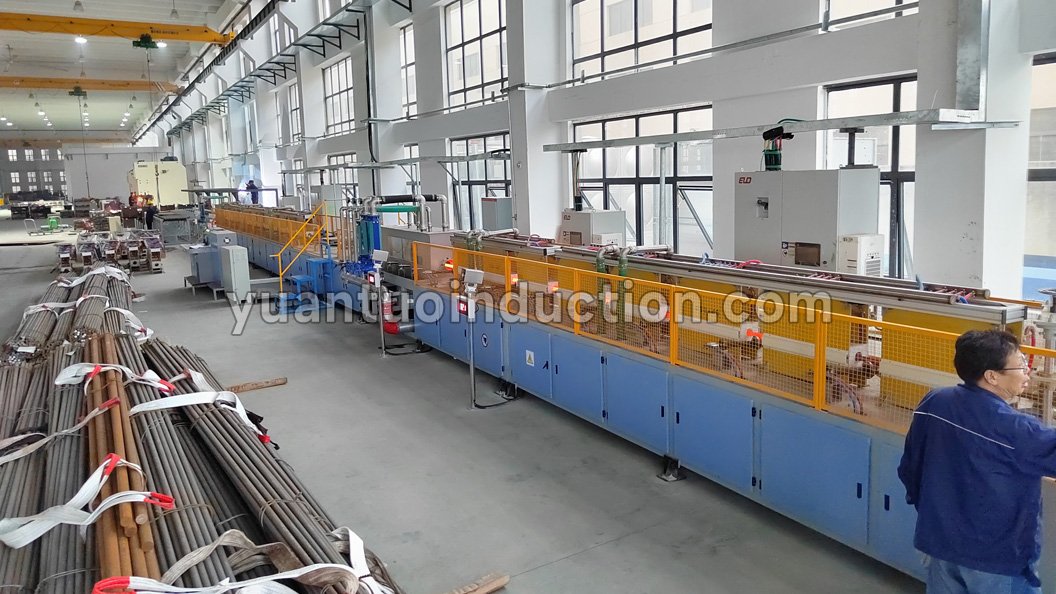
Consider a steel bar heat treatment project covering:
Ø20–100 mm
If the complete line is designed only around Ø100 mm:
At first glance, Ø20 mm bars can obviously pass through the same line.
But:
Being able to pass through the equipment does not mean the size is optimized for production.
Ø20 mm and Ø100 mm bars differ significantly in:
Therefore:
Maximum Workpiece Size ≠ Complete Product Range Design
The maximum size is one engineering boundary, not the complete basis for production-line configuration.
Induction heating is not simply a matter of:
Larger workpiece = higher power.
When the workpiece dimensions change significantly, its electromagnetic and thermal heating behavior also changes.
For example, smaller and larger diameter steel bars may require different combinations of:
If a very wide size range is forced into exactly the same heating configuration:
Some sizes may still be technically processable, but they may not operate within an efficient or stable process window.
For multi-size production, the engineering logic should therefore consider:
Workpiece Size
↓
Material Grade
↓
Heating Depth / Thermal Requirement
↓
Frequency
↓
Power
↓
Line Speed
This is why:
One power supply covering the entire size range does not automatically mean one optimized heating configuration for every size.

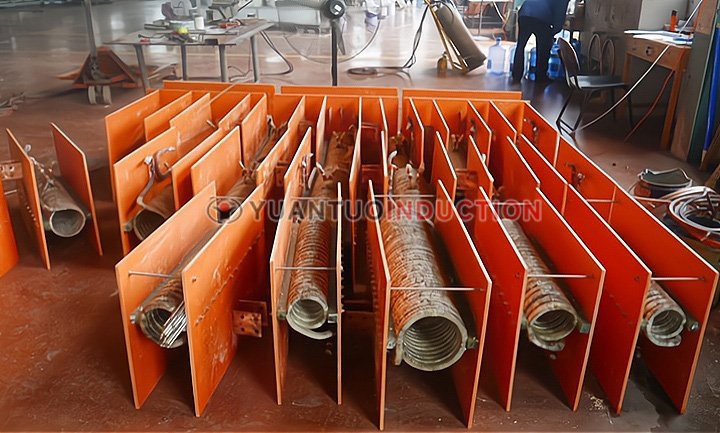
The inductor directly affects electromagnetic coupling between the heating system and the workpiece.
When workpiece dimensions change significantly:
The geometric relationship between the workpiece and the inductor also changes.
If an inductor designed for a much larger workpiece is used for a small workpiece, it may affect:
For this reason, a multi-size production line may require:
For example, the complete product range may be divided into:
Small Size Range
↓
Medium Size Range
↓
Large Size Range
rather than trying to achieve:
One Inductor for Everything
For long-term industrial production, sensible size grouping can be more practical than maximizing the theoretical range of a single inductor.
During project discussions, a buyer may say:
“We need 5 t/h.”
If the product range is wide, another question immediately becomes important:
“For which size do you require 5 t/h?”
On the same steel bar production line, small and large workpieces may have different:
Therefore, a multi-size production line should not always be described using only one:
Maximum Capacity
A more useful approach is to evaluate the main product groups separately:
| Product Group | Capacity Information |
|---|---|
| Small Sizes | Main diameter + required t/h |
| Medium Sizes | Main diameter + required t/h |
| Large Sizes | Main diameter + required t/h |
For an industrial project:
The main production sizes are often more important than a maximum size that is produced only occasionally.
Two workpieces with exactly the same dimensions may require very different heat treatment conditions if their material grades are different.
For example:
may require different:
Therefore, a multi-size production line should not be evaluated only through a:
Size Range
It is more useful to establish a:
Size + Material + Process Matrix
For example:
Ø30 mm + Material A + Quenching & Tempering
and
Ø30 mm + Material B + Heating Only
have the same diameter but represent different production conditions.
This is an important issue that can be overlooked before equipment purchasing.
After the line enters long-term production, one factor directly affects operating efficiency:
Product Changeover
Changing from one product size to another may involve:
If every product change requires extensive mechanical adjustment:
A line may have a very wide theoretical size range but still be inefficient in actual production.
Therefore, before designing a multi-size line, it is useful to know:
These answers can directly influence the production-line design.
Once stable process parameters have been established for different products, they can be managed as production recipes.
For example:
Recipe A — Small Size
Recipe B — Medium Size
Recipe C — Large Size
Depending on the actual project, a recipe may manage parameters such as:
After the necessary mechanical changeover is completed, recipe management can reduce repeated manual parameter entry and improve process consistency.
However:
PLC Recipe Management Cannot Replace Mechanical and Electromagnetic Matching.
If the inductor, conveying system or spray system is not suitable for a particular workpiece, changing the PLC recipe alone cannot solve the problem.

If the product range is extremely wide, using one line is not automatically the most practical solution.
Consider a project that includes:
with major differences in:
In this case, two approaches can be compared.
Potential advantages:
But the project still needs to evaluate:
For example:
Small / Medium Size Line
Large Size Line
Although this requires additional equipment, it may provide:
Therefore:
One line should not automatically be considered more economical than two lines.
The decision should be based on the customer’s actual product mix and production plan.
Suppose a customer has a product range of:
Ø20–120 mm
but the actual annual production mix is:
If the complete line is heavily optimized around the largest 5% of products while compromising:
for the 70% main product group, the overall production strategy may not be ideal.
For this reason, when designing a customized induction heating line, it is more useful to receive:
Product Range + Main Sizes + Production Percentage
rather than only:
Minimum Size + Maximum Size
This information can significantly improve the quality of the initial engineering evaluation.
A practical engineering sequence is:
Complete Product Range
↓
Main Production Sizes
↓
Material Grades
↓
Heat Treatment Processes
↓
Capacity for Each Main Size
↓
Frequency & Power Matching
↓
Inductor Grouping
↓
Conveying / Quenching Adjustment
↓
Changeover Strategy
↓
PLC Recipe Management
↓
Complete-Line Verification
rather than:
Maximum Size
↓
Select Maximum Power
↓
Try to Process Everything
For a customized continuous production line:
A good product range is not simply the widest range shown on the equipment specification sheet.
The real objective is:
To ensure that the customer’s main products can be manufactured with reasonable heating performance, production capacity, changeover efficiency and long-term process stability.
| Parameter | Recommended Information |
|---|---|
| Minimum Size | Minimum diameter or cross-section |
| Maximum Size | Maximum diameter or cross-section |
| Main Production Sizes | 3–5 most frequently produced sizes |
| Production Mix | Annual volume or percentage by size |
| Length Range | Minimum, maximum and typical length |
| Material Grades | Steel grade for each product group |
| Process | Heating, hardening, Q&T, etc. |
| Target Temperature | Requirement for each main product |
| Target Properties | Hardness or mechanical properties |
| Required Capacity | t/h or pcs/h for each main size |
| Changeover Frequency | Per shift, daily, weekly, etc. |
| Automation Requirements | Recipes, data recording, communication, etc. |
Compared with simply saying:
“We need Ø20–120 mm.”
this information allows the engineering team to determine whether:
One production line or multiple size-grouped lines would be more appropriate.
In some projects, a relatively wide size range is technically possible. However, frequency, power, inductor matching, conveying, required capacity and changeover efficiency still need to be evaluated. Being technically processable does not mean every size operates under equally suitable production conditions.
Because smaller and larger workpieces can require different heating conditions, frequencies, line speeds and production takt. Installed power is only one part of the complete engineering design.
Not necessarily. It depends on the size range, inductor design and process requirements. However, when the dimensional difference is large, grouping workpiece sizes and using matched inductors can provide more practical heating conditions.
Validated process parameters can be stored and recalled through recipe management. However, any required mechanical, inductor or spray-system changeover must still be completed according to the actual equipment design.
When small and large products both represent significant production volume and require substantially different frequency, power, line speed or mechanical configurations, dividing the range between two lines may be worth evaluating.
If your project includes a wide range of workpiece sizes, providing only:
Minimum Size + Maximum Size
is usually not enough for a useful engineering evaluation.
More valuable information includes:
Product Range + Main Sizes + Production Percentage + Material Grades + Heat Treatment Process + Required Capacity + Changeover Frequency
Hebei Yuantuo Electromechanical develops customized complete-line solutions by matching:
Frequency + Power + Inductor + Conveying + Quenching + Tempering + Temperature Control + PLC Recipe Management
to the customer’s actual production requirements.
For projects with a particularly wide size range, the engineering evaluation may compare:
One Wide-Range Production Line
with
Two Production Lines Divided by Size Range
The objective is not to make the “applicable size range” on a specification sheet as wide as possible.
The objective is:
To achieve practical heating performance, production capacity, efficient changeover and stable long-term operation for the sizes the customer actually produces most often.
WhatsApp:+86 15226757228
Email:yuantuo38@gmail.com
Website:www.yuantuoinduction.com
