
Induction heating, rolling mill takt, hot-ball conveying and downstream heat treatment all affect the actual output of the complete line
In a hot rolled steel ball project, one of the first questions is often:
“How many tons per hour can the rolling mill produce?”
This is an important parameter.
However, in a continuous production line, the rated capacity of the rolling mill is not automatically the actual capacity of the complete line.
A typical hot rolled grinding ball production process may include:
Steel Bar Loading → Induction Heating → Temperature Measurement → Ball Rolling → Hot Ball Conveying → Cooling / Quenching → Tempering, if required → Ball Collection
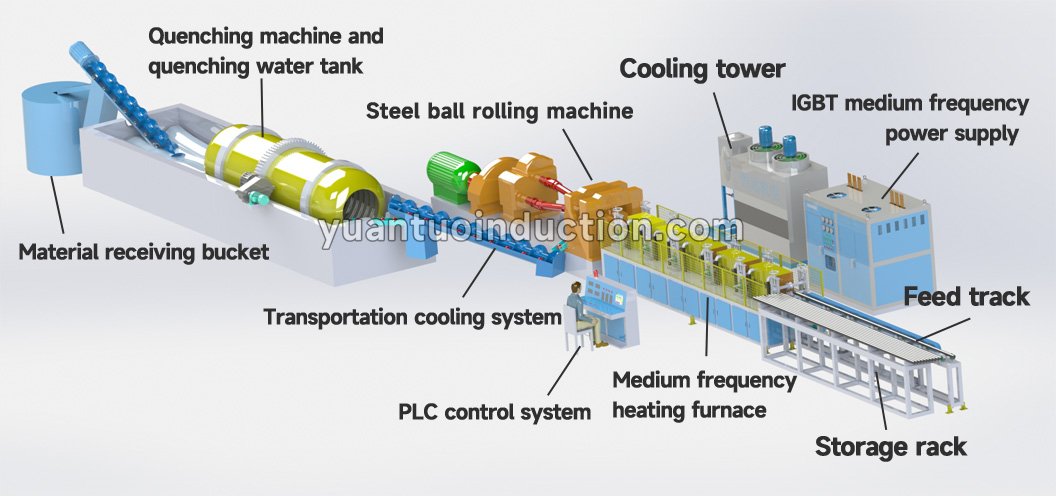
If any one of these sections cannot keep up with the required production rate, it can limit the output of the entire line.
Therefore, when production capacity is lower than expected, the better question is:
“Where is the bottleneck in the complete production line?”
rather than simply:
“Can the rolling mill run faster?”
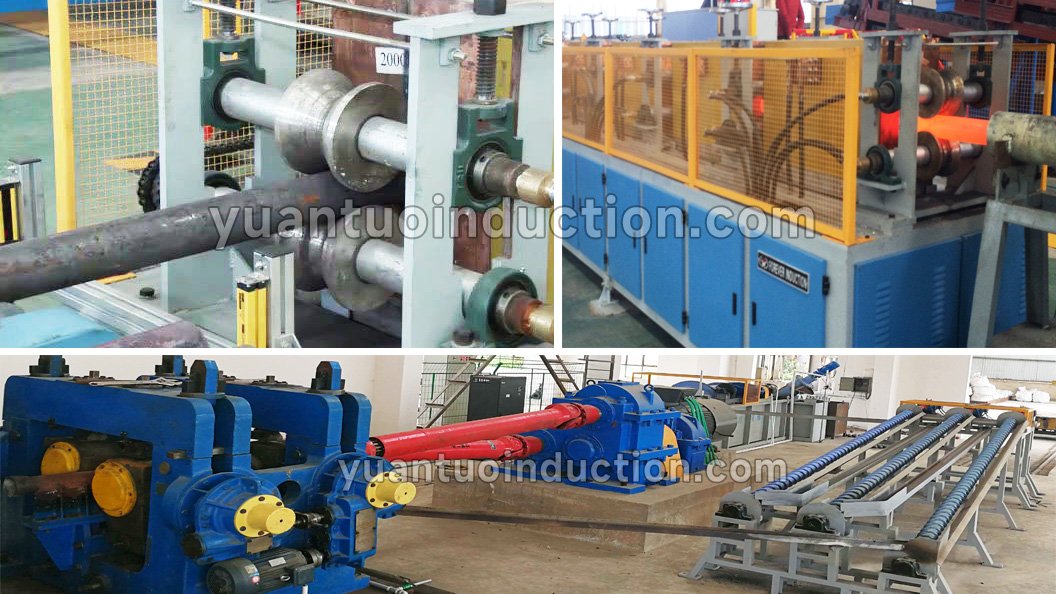
Before rolling, the steel bar needs to be heated to the appropriate temperature range for ball forming.
In continuous production, the induction heating section must provide the rolling mill with:
Suppose the rolling mill has a relatively high rated capacity, but the induction heating section can continuously provide only a lower tonnage of properly heated steel bar.
In that case:
The rated capacity of the rolling mill cannot be converted into actual complete-line output.
The induction heating section therefore needs to be matched according to:
Bar Diameter + Material Grade + Target Rolling Temperature + Required t/h + Rolling Mill Takt
This is why the induction heating system and the steel ball rolling mill should not be selected as two completely independent pieces of equipment.
If the front-end material supply cannot keep up with the rolling mill, one possible response is:
“Increase induction power and heat the bar faster.”
But the production line does not simply need faster heating.
It needs:
A stable supply of steel bar within the required rolling temperature window and at the correct production rate.
If heating speed is increased without properly considering:
the process may become unstable.
For example:
Surface Temperature Rises Quickly
↓
Required Thermal Condition Through the Bar Section Is Not Achieved
↓
Bar Enters the Rolling Mill
↓
Ball Forming Stability May Be Affected
Therefore:
Heating Speed ≠ Effective Production Capacity
A more meaningful parameter is:
Qualified Heated Bar Supply Rate
In other words, how many tons of properly heated steel bar can the system continuously supply to the rolling mill per hour?
One steel ball production line may need to manufacture several ball diameters, for example:
Ø50 / Ø60 / Ø70 / Ø80 mm
Different grinding ball sizes may correspond to different:
Therefore, even on the same production line:
Actual capacity in t/h may vary between different ball sizes.
This is why it is not always appropriate to state:
“The line produces the same tonnage for every ball diameter.”
A more practical engineering evaluation follows this logic:
Target Ball Diameter
↓
Required Steel Bar Diameter
↓
Bar Weight per Meter
↓
Heating Requirement
↓
Rolling Takt
↓
Actual Production Capacity
For multi-size projects, the main production sizes should be evaluated individually rather than relying only on one maximum theoretical capacity.
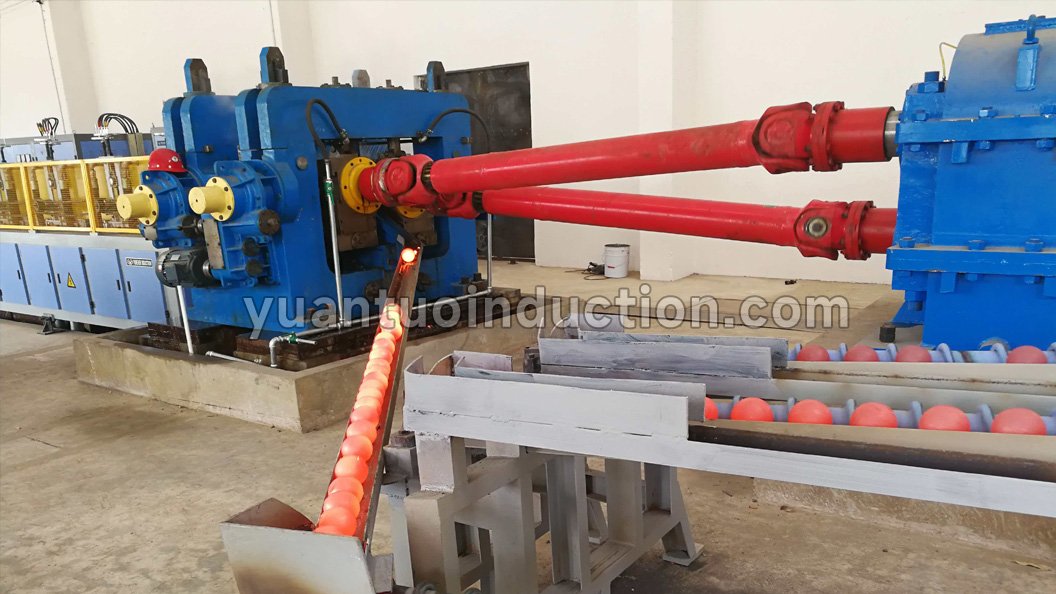
A steel ball rolling mill does not simply require a “red-hot steel bar.”
It requires material within an appropriate rolling temperature window.
If continuous heating produces:
the rolling process may require adjustments to:
This directly affects continuous production stability.
Therefore:
Temperature stability is part of production capacity.
Heating one good bar during a short test does not prove that a production line can operate continuously at the required output.
A more important question is:
Can every steel bar entering the rolling mill remain within a stable process window during continuous production?
The main front and middle sections of the production line can be viewed as two connected systems.
Its task is to:
Continuously supply heated steel bar at the required temperature and production rate.
Its task is to:
Continuously form steel balls according to the required rolling takt.
If:
Heating Output < Rolling Mill Demand
the result is:
The rolling mill waits for heated material.
If:
Heating Output > Rolling Mill Capacity
the result may be:
Heated steel bar waits before rolling, and its thermal condition changes.
Therefore, a properly engineered production line should achieve:
Heating Output ≈ Rolling Mill Demand
while maintaining sufficient process adjustment capability.
This is the core principle of takt matching in a hot rolled steel ball production line.
Internal Link: Induction Heating System for Steel Ball Rolling
Production does not end when the steel ball leaves the rolling mill.
The hot balls still need to pass through downstream processes such as:
If rolling speed increases but the hot-ball conveying system cannot handle the increased output, problems may include:
The hot-ball conveying system should therefore be matched according to:
The conveyor is not simply used to move balls from one point to another. It is part of the continuous production rhythm.
If the grinding ball project includes downstream heat treatment, capacity verification needs to continue beyond the rolling mill.
For example:
Rolling Mill Capacity: 8 t/h
but:
Quenching Section Capacity: 6 t/h
The complete production line cannot continuously maintain an actual output of 8 t/h.
The same applies to the tempering section.
If its processing capacity is lower than the upstream output, it becomes another bottleneck.
Therefore, complete-line capacity should be checked through every stage:
Raw Bar Feeding
↓
Induction Heating
↓
Ball Rolling
↓
Hot Ball Conveying
↓
Quenching
↓
Tempering
↓
Collection
The key principle is:
The actual continuous capacity of the complete line is limited by its slowest process section.
Internal Link: Grinding Ball Heat Treatment Line
Use only if a corresponding page exists on the website.
Actual production does not always operate at a perfectly fixed rhythm.
Temporary variations may occur because of:
Therefore, a stable grinding ball production line requires more than matching the theoretical capacity of individual machines.
The complete system may also need:
For example, if rolling mill speed changes, the upstream feeding and induction heating sections should respond according to the complete-line control logic rather than continuing to operate at an independent fixed rate.
This is the difference between:
Single Machine Capacity
and:
Complete Line Production Stability
A practical engineering sequence is:
Target Ball Diameter
↓
Steel Bar Size & Material
↓
Target Rolling Temperature
↓
Required Ball Output
↓
Required Heated Bar Throughput
↓
Induction Heating Capacity
↓
Rolling Mill Takt
↓
Hot Ball Conveying Capacity
↓
Quenching / Tempering Capacity
↓
Complete-Line Capacity Verification
Instead of:
Selecting an “8 t/h rolling mill” and assuming that the complete production line will automatically produce 8 t/h.
| Parameter | Recommended Information |
|---|---|
| Ball Diameter | Minimum, maximum and main production sizes |
| Steel Bar Diameter | Corresponding bar size for each ball diameter |
| Steel Bar Length | Typical raw material length |
| Material Grade | B2, B3, B6, 65Mn, 40Cr or other grades |
| Rolling Temperature | If an existing process requirement is available |
| Target Capacity | t/h or balls/min |
| Rolling Mill | Model and actual capacity if already installed |
| Downstream Process | Cooling, quenching and/or tempering |
| Target Properties | Hardness and other required properties |
| Production Mode | Single size or multi-size production |
If the customer already has a steel ball rolling mill and only requires the upstream induction heating section, it is also useful to provide:
Rolling Mill Model + Ball Size + Actual Rolling Takt
The induction heating system should be matched to the real demand of the existing rolling process rather than designed around an independent theoretical capacity.
Not necessarily. Steel bar feeding, induction heating, hot-ball conveying, quenching and tempering must all be able to continuously support the same production rate.
Not necessarily. Steel bar diameter, material grade, frequency, effective heating length, target rolling temperature and rolling mill takt all need to be considered. Higher output must still satisfy the required heating conditions before rolling.
Different ball sizes may require different steel bar diameters, heating conditions, ball weights and rolling takt. Therefore, actual output in t/h can vary even on the same production line.
Yes. However, the induction heating section should be engineered according to the actual rolling mill takt, ball size, steel bar diameter, material grade and required rolling temperature.
If downstream heat treatment is part of the continuous production line, its processing capacity can also limit the actual output of the complete line.
For a hot rolled grinding ball project, the key question is not:
“Which individual machine is the fastest?”
A more useful engineering question is:
“Can every continuous process—from raw steel bar feeding to ball rolling and downstream heat treatment—operate at a coordinated production takt?”
Hebei Yuantuo Electromechanical designs customized complete production solutions according to:
Ball Diameter + Steel Bar Size + Material Grade + Rolling Temperature + Required Capacity + Rolling Mill Takt + Heat Treatment Requirements
The engineering scope can coordinate steel bar feeding, induction heating, temperature control, rolling mill connection, hot-ball conveying and downstream heat treatment according to the actual production process.
If a rolling mill is already installed, please provide:
Ball Size / Bar Diameter / Material Grade / Rolling Mill Capacity / Required t/h
These parameters can be used to evaluate the required induction heating capacity and takt matching with the existing rolling equipment.
WhatsApp:+86 15226757228
Email:yuantuo38@gmail.com
Website:www.yuantuoinduction.com
