
When planning a steel plate heat treatment project, plate thickness is usually one of the first parameters to be considered.
It is important because it affects the amount of metal and the heating conditions through the plate section.
However, thickness alone is not enough to determine a customized steel plate induction heat treatment system.
For example, consider two steel plates with the same thickness of 20 mm:
One plate is 500 mm wide, while the other is 1,500 mm wide.
Although their thickness is identical, the effective heating width, amount of material being processed, induction coil design and conveying requirements can be significantly different.
If material grade, plate length, target temperature, heat treatment process and production capacity also vary, the final system configurations may be very different.
Therefore:
Plate thickness is an important design parameter, but it should not be used as the only basis for selecting a steel plate heat treatment system.
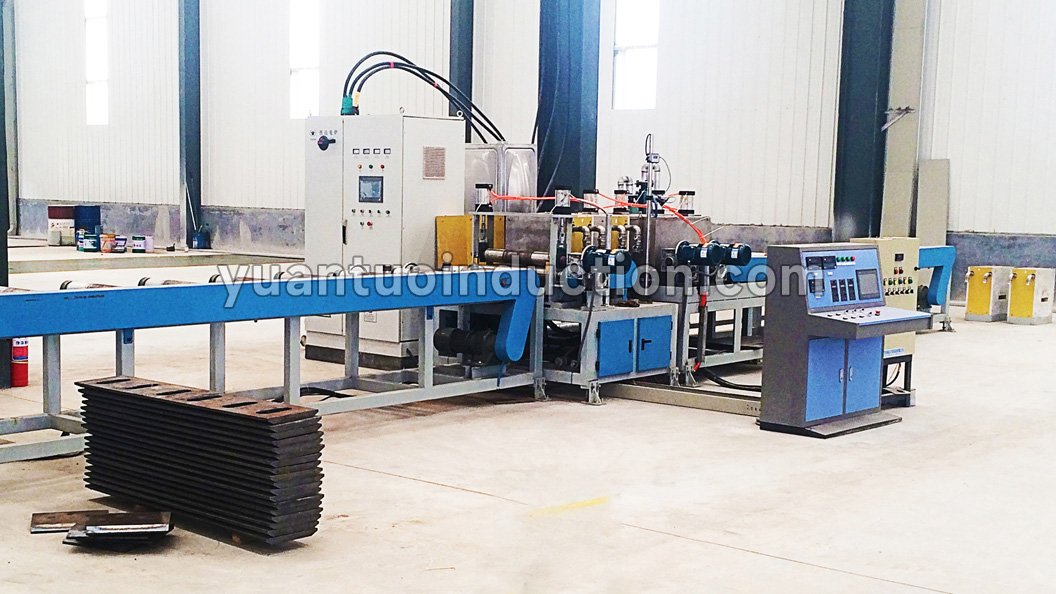
For steel plate induction heating, thickness mainly affects the heating conditions through the section, while plate width determines the effective area that needs to be heated.
Before engineering design, it is therefore important to confirm:
For full-width continuous processing, the heating system needs to consider the temperature condition across the entire plate width.
For localized heat treatment, the induction coil and conveying arrangement need to be designed according to the actual treatment area.
As a result, plates with the same thickness do not necessarily use the same induction heating configuration.
For continuous steel plate heat treatment:
“The maximum temperature has reached the target”
and
“The complete required treatment area has reached the specified process condition consistently”
are not the same thing.
If significant temperature differences exist across the plate width, one measurement point reaching the target temperature does not necessarily mean that the complete plate has been heated uniformly.
Engineering design should therefore consider:
Induction coil design, power distribution, conveying speed and online temperature monitoring need to work together.
For processes requiring through-heating, the temperature condition through the plate thickness should also be considered rather than relying only on a surface temperature reading.
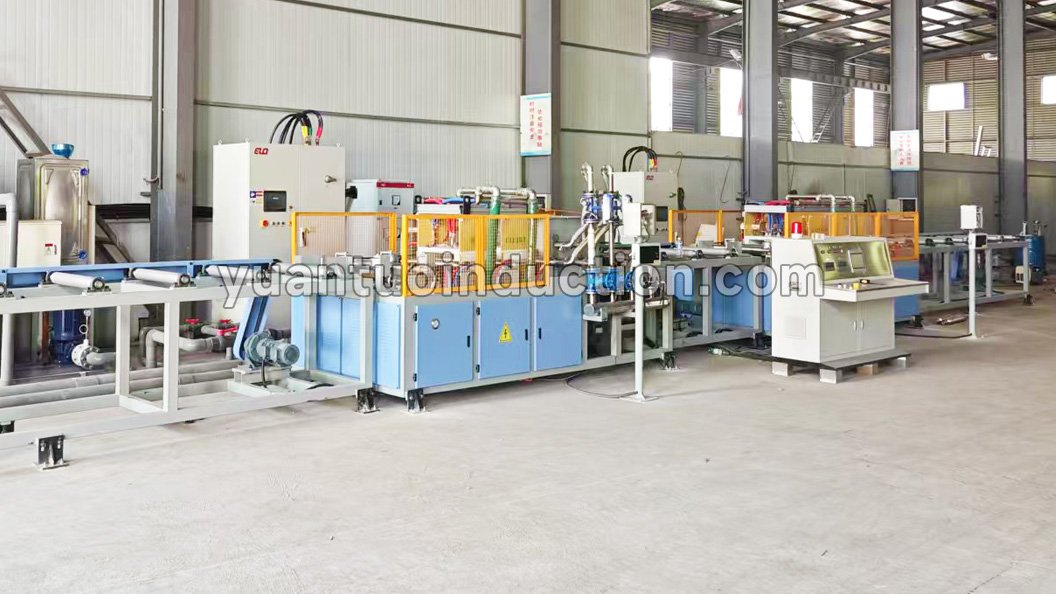
Even when plate dimensions are identical, different material grades and final property requirements may require different heat treatment solutions.
Before designing the equipment, the required process should be clearly defined.
Typical applications may include:
It is also important to provide:
The objective is not simply to make the steel plate hot.
The heating and cooling process should be designed according to the required heat treatment result.
If the process includes quenching, induction heating is only the first part of the production process.
After reaching the required quenching temperature, the plate needs to enter the cooling section under controlled conditions.
The complete process may include:
Induction Heating → Plate Conveying → Temperature Measurement → Quenching Cooling → Further Conveying / Tempering
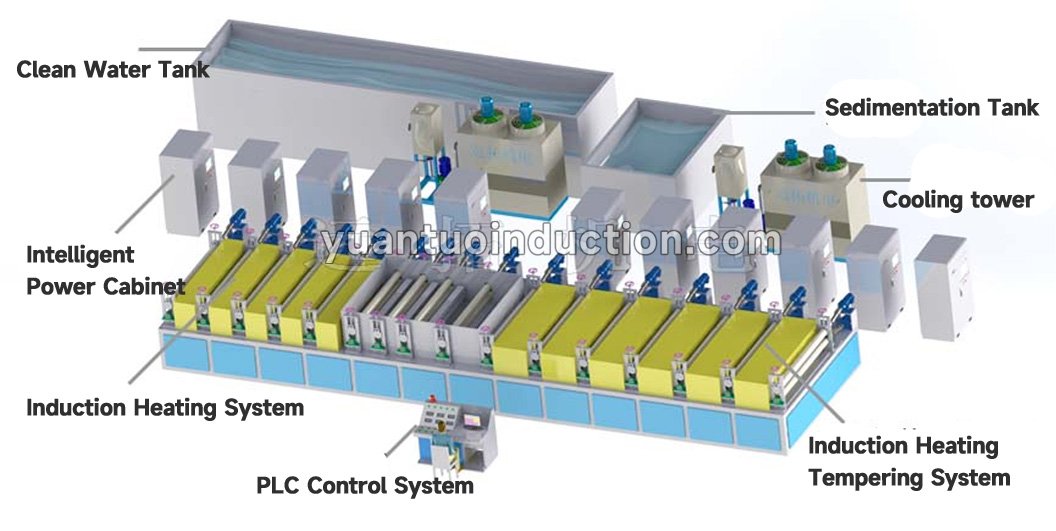
Therefore, the distance between heating and quenching sections, plate travel speed, spray arrangement and cooling conditions should be considered together.
For wider or thinner plates, cooling uniformity across different areas of the plate and the risk of distortion may also require particular attention.
For this reason, the induction heating section and quenching cooling system should not be designed as two completely independent pieces of equipment.
In a continuous steel plate heat treatment line, the workpiece must not only be heated—it also needs to travel reliably through the complete process.
The production line therefore needs to consider:
For long plates, conveying and support become particularly important.
If equipment selection focuses only on induction heating power without considering the mechanical conveying system, stable continuous operation of the complete line may be affected.
Consider two projects processing steel plates with the same dimensions and material grade.
Project A: relatively low hourly production capacity
Project B: continuous high-capacity production
The same equipment configuration cannot automatically be applied to both projects.
Production capacity determines how much metal needs to be processed within a given time and therefore affects:
For this reason, a steel plate heat treatment project should specify production requirements in:
t/h, pieces/h or production takt time.
For a continuous production line, the engineering objective is not only:
Can one steel plate reach the required process condition?
The more important question is:
Can every plate passing continuously through the line be treated consistently at the required production rate?
For an initial evaluation of a customized plate induction heating, quenching or Q&T system, it is recommended to provide:
| Parameter | Information Required |
|---|---|
| Plate Thickness | Minimum, maximum and common thickness |
| Plate Width | Minimum, maximum and common width |
| Plate Length | Minimum, maximum and common length |
| Material | Steel grade |
| Treatment Area | Full plate or localized area |
| Process | Heating, quenching, Q&T, etc. |
| Target Temperature | Required process temperature |
| Final Properties | Hardness, strength, hardening depth, etc. |
| Production Capacity | t/h, pieces/h or takt time |
| Plant Conditions | Installation space, line connection and handling method |
If several plate sizes need to be processed on the same system, it is also useful to provide:
Common sizes + Production share of each size + Changeover frequency
This information helps engineers evaluate the induction heating, conveying, quenching and automatic control requirements according to actual production conditions.
For a customized steel plate heat treatment project, the engineering logic should normally follow:
Plate Dimensions → Material Grade → Heat Treatment Target → Heating Temperature & Uniformity Requirements → Production Capacity → Induction Coil & Effective Heating Area → Conveying & Support → Quenching Cooling → Automatic Control
Therefore, a steel plate heat treatment system should not be selected simply by asking:
“How many kW are required for a 20 mm steel plate?”
The more important engineering question is:
How should heating, conveying and cooling be integrated to meet the customer’s actual plate specifications, material grade, heat treatment process and production capacity?
Usually not. Plate width, length, material grade, target temperature, heat treatment process and production capacity should also be evaluated before determining the equipment configuration.
Plate width affects the effective heating area and can influence induction coil design, power distribution and transverse temperature uniformity.
Not exactly. Induction heating provides the required thermal input. If quenching is required, the complete system also needs suitable conveying, temperature monitoring and rapid cooling sections.
In some projects, yes. However, the complete size range, material grades, process requirements and production mix should be evaluated. A wide specification range may require additional consideration for changeover and process parameter adjustment.
Plate length affects loading, roller support, continuous conveying, quenching and unloading system design.
Plate thickness is only one of the basic parameters for designing a customized heat treatment system.
For steel plate and heavy plate induction heating, quenching or quenching and tempering projects, it is recommended to provide:
plate thickness, width, length, material grade, treatment area, target temperature, required properties and production capacity.
WhatsApp:+86 15226757228
Email:yuantuo38@gmail.com
Website:www.yuantuoinduction.com
Based on these actual operating conditions, engineers can further determine the induction coil configuration, heating capacity, effective heating area, roller conveying system, quenching cooling system and automatic control solution.
The objective is not to supply an isolated induction heater, but to develop a customized steel plate heat treatment system matched to the customer’s actual production process.
