
In steel bar induction hardening and tempering production, uneven hardness after quenching is a common quality issue. It appears as large hardness variation along the same bar (e.g., 5‑8 HRC difference) or significant fluctuation within the same batch.
Many factors can cause uneven hardness, but on‑site statistics show that the spray cooling system is the most common and most overlooked culprit. This article focuses on three key parameters of the spray system – water pressure, temperature, and flow – and provides three immediately actionable on‑site checks.

Quenching is essentially rapid cooling of steel bars from austenitizing temperature (typically 800‑950°C) to obtain martensite or bainite. The cooling rate must be sufficiently high and uniform to ensure consistent hardness.
Low or uneven water pressure – insufficient spray coverage in some areas, slow cooling, leading to soft spots.
High water temperature – reduced cooling capacity; especially during continuous production, rising quench tank temperature significantly lowers hardenability.
Insufficient flow rate – not enough heat removed per unit time, preventing the bar from completing transformation above the critical cooling rate.
Therefore, when uneven hardness occurs, the spray system should be the first item to check.
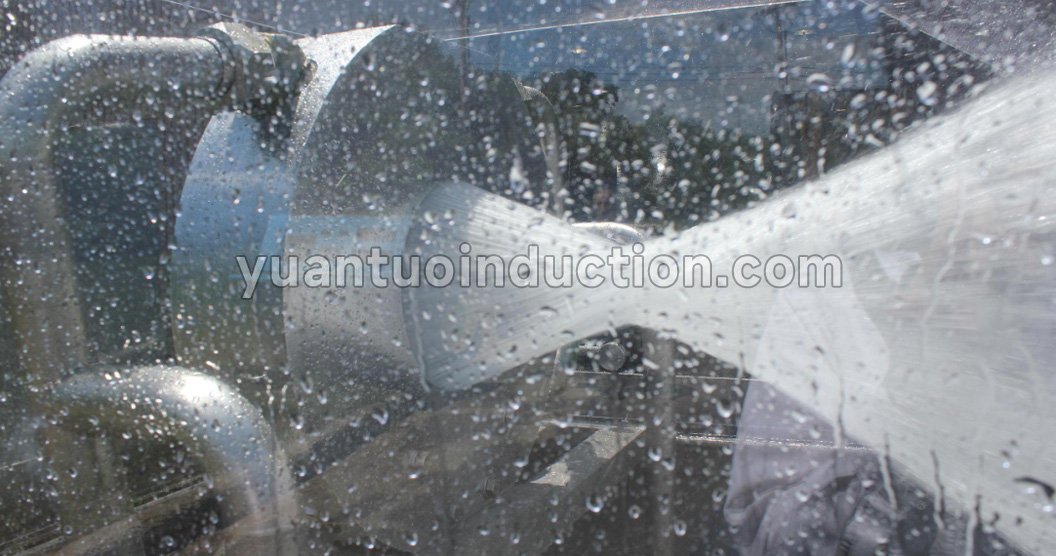
Procedure:
Read the pressure gauge on the quench tank – confirm it is within the process setpoint (e.g., 0.3 MPa ± 0.05 MPa).
Energize the spray system and observe the spray ring nozzles – look for clogging, deflected jets, or obvious pressure differences.
For multi‑ring systems, check each ring’s individual pressure.
Common issues and solutions:
Low pressure → check pump, filter blockage, pipe leaks.
Local clogging → disassemble and clean the spray ring (scale buildup is common with recirculated water).
Pressure fluctuation → inspect variable frequency pump or pressure regulating valve.
Procedure:
Measure water temperature at the quench tank outlet or spray ring inlet (use thermocouple or infrared thermometer).
Record temperature variation over 1 hour of continuous production.
Confirm if a cooling tower or heat exchanger is installed and operating.
Common issues and solutions:
Water temperature > 45°C → cooling capacity is severely reduced; increase cooling tower power or recirculation rate.
Temperature fluctuation > ±5°C → add temperature control valve or PLC interlock.
Insufficient once‑through water volume (reference: 100 m³ baseline) → check make‑up water system.
Procedure:
Read the flow meter and compare to the design value (e.g., 500 m³/h).
At rated pressure, measure actual water volume per unit time (e.g., collect under the spray ring and weigh).
Check flow balance among rings – adjust branch valve openings.
Common issues and solutions:
Total flow too low → pump undersized or excessive pipe resistance.
Large flow difference between rings → adjust branch valves to equalize cooling intensity.
Flow drops over time → filter clogging or low tank level.
To prevent uneven hardness, include spray parameters in every shift’s routine check. Record:
Water pressure (MPa)
Water temperature (°C)
Total flow rate (m³/h)
Spray ring condition (OK / clogged)
Once hardness fluctuation occurs, you can quickly trace back to the day’s spray data and shorten troubleshooting time.
Summary: When steel bar quenching results in uneven hardness, prioritize the spray cooling system. Checking water pressure, temperature, and flow using the three checks above will locate most problems within 30 minutes. If all three are normal, then further inspect induction heating temperature uniformity or bar material consistency.
Yuanto Machinery’s steel bar quenching and tempering lines are equipped with quench tanks and stainless steel spray rings, supporting on‑line monitoring of water pressure, temperature, and flow – helping users keep real‑time control of cooling status. For technical discussion or on‑site diagnostic support, please provide your equipment parameters and anomaly description.
Website:yuantuoinduction.com
WhatsApp:+86-15226757228
Email:yuantuo38@gmail.com
