
In oil drilling applications, drill pipes are required to withstand complex working conditions, including tension, torsion, impact, and repeated mechanical stress. To improve the overall mechanical properties of drill pipes, quenching and tempering is an important heat treatment process.
A drill pipe quenching and tempering line is a continuous heat treatment production line designed for oil drill pipes and similar long tubular workpieces. It usually adopts induction heating technology, combined with spray cooling, temperature measurement, PLC control, and automatic conveying systems, to complete the quenching and tempering process in a stable and continuous way.
Hebei Yuantuo Electromechanical Equipment Manufacturing Co., Ltd. focuses on customized induction heating systems and complete heat treatment lines. This article introduces the basic composition, process flow, and technical features of a drill pipe quenching and tempering line.

Drill pipes work under demanding downhole conditions. They need not only sufficient strength and hardness, but also good toughness and stable mechanical performance.
Quenching is mainly used to improve the strength and hardness of the material. Tempering is used after quenching to reduce internal stress and improve toughness. Through a proper quenching and tempering process, drill pipes can obtain more balanced mechanical properties.
For long tubular workpieces such as drill pipes, the key is not only heating the pipe to the required temperature. More importantly, the production line must maintain stable heating, uniform cooling, proper conveying speed, and coordinated operation between each process section.
This is why drill pipe heat treatment usually requires a complete production line solution instead of a single heating machine.
A complete drill pipe quenching and tempering line generally consists of several systems. The configuration can be customized according to pipe size, material grade, production capacity, and heat treatment requirements.
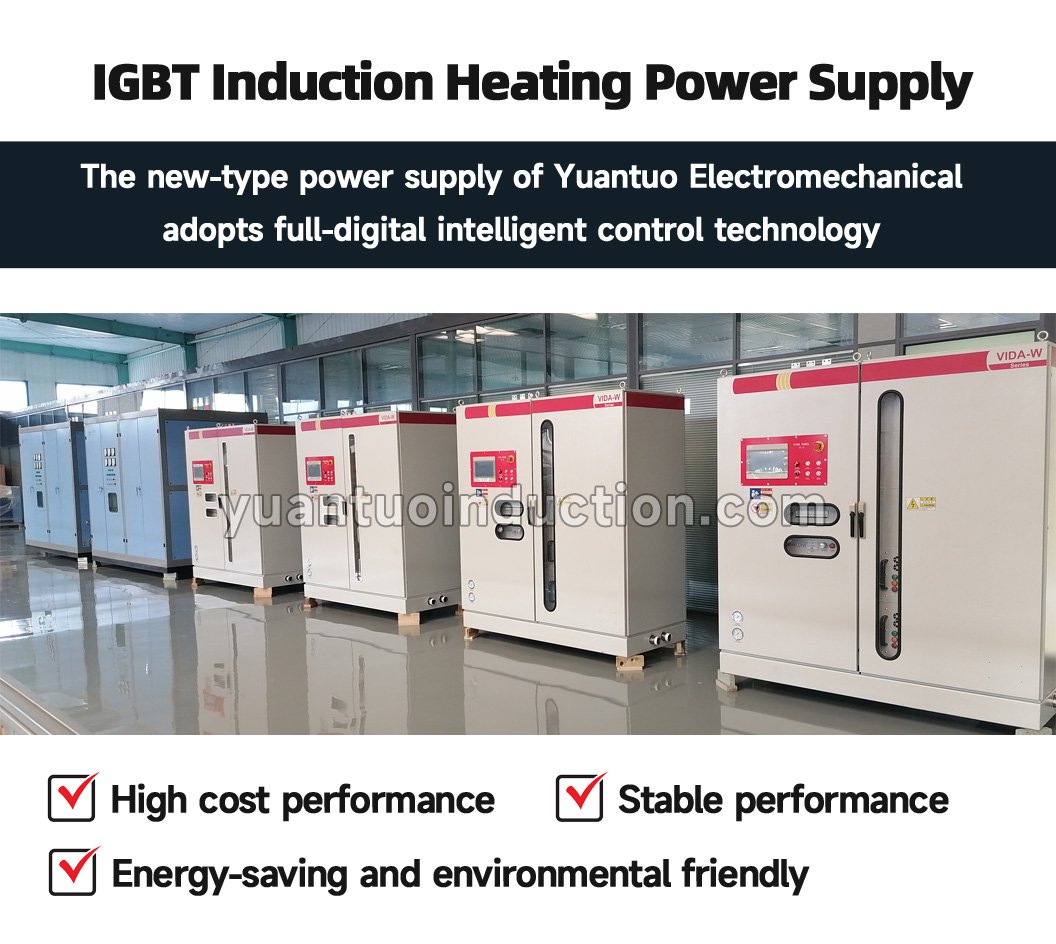
The induction power supply provides heating power for the quenching heating section, tempering heating section, and possible supplementary heating sections.
The power capacity and frequency selection need to be matched with the drill pipe diameter, wall thickness, heating temperature, line speed, and production capacity.
Before quenching, the drill pipe passes through the induction heating coils and is heated to the required quenching temperature.
Heating uniformity is very important in this section, because it directly affects the following cooling result and the final material structure.
After quenching heating, the drill pipe enters the spray cooling section. The cooling system should be designed according to the pipe size, wall thickness, material, and quenching process.
Cooling intensity, spray distribution, water flow, and cooling length are all important factors in the final heat treatment result.
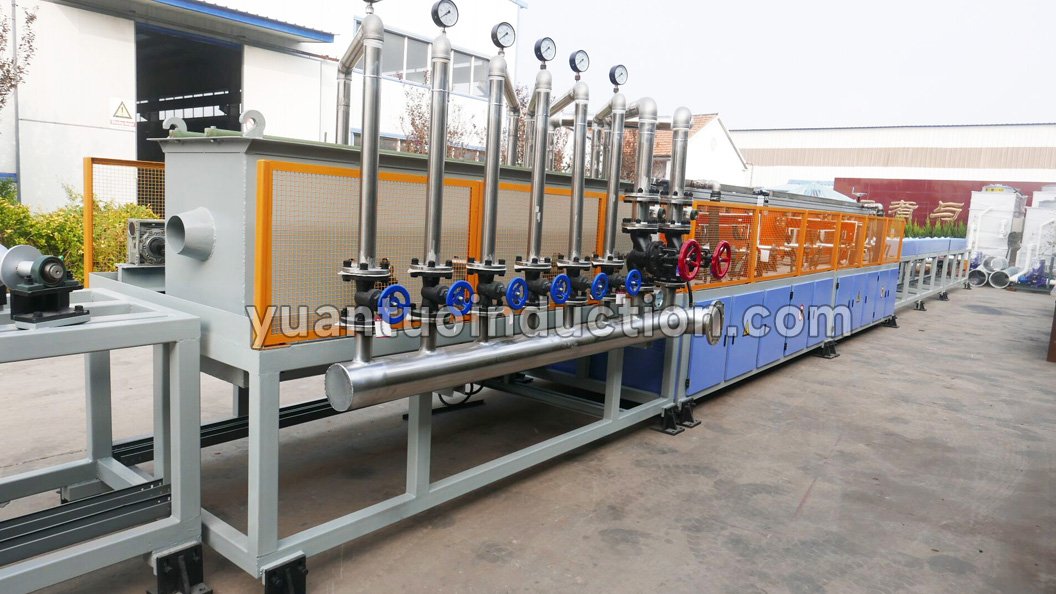
After quenching and cooling, the drill pipe needs tempering treatment. Tempering helps reduce quenching stress and improve toughness, making the pipe obtain more stable comprehensive mechanical properties.
The infrared temperature measuring system is used to monitor the pipe temperature online. The measured temperature can be compared with the preset temperature value, and the heating power can be adjusted through the control system.
This helps improve temperature stability during continuous production.
The PLC control system manages the operation of the whole line. Operators can set and monitor heating temperature, conveying speed, power output, cooling status, alarm information, and other process parameters through the touch screen.

The conveying system usually includes loading rack, feeding device, driven rollers, discharge roller table, and collection rack. It ensures that the drill pipe can move through each process section continuously and smoothly.
A typical drill pipe quenching and tempering line may follow this process flow:
Pipe loading → Single pipe feeding → Quenching induction heating → Temperature measurement → Spray cooling → Tempering induction heating → Tempering temperature measurement → Final cooling → Straightening → Discharging → Finished pipe collection
In some projects, supplementary heating sections may be added according to process requirements. For example, if the pipe has upset ends or different wall thickness areas, the line may need additional heating control to improve temperature consistency.
The final process design should be based on actual pipe specifications and production requirements.
Induction heating generates heat inside the metal workpiece through electromagnetic induction. It provides fast heating speed and is suitable for continuous through-type heating of long tubular workpieces.
For drill pipe heat treatment, induction heating can be integrated with automatic conveying systems to form a continuous production line.
With infrared temperature measurement and PLC control, the system can monitor the pipe temperature during production and adjust heating power according to the actual process condition.
Stable temperature control is important for reducing batch-to-batch differences and improving process repeatability.
Because induction heating has a relatively fast heating speed, the pipe stays at high temperature for a shorter time. This can help reduce surface oxidation and decarburization compared with some traditional long-time heating methods.
The actual result depends on the material, temperature, heating time, and site process conditions.
A drill pipe quenching and tempering line can realize automatic loading, continuous conveying, induction heating, spray cooling, tempering, straightening, and discharging.
This helps reduce manual operation and improve production consistency.
Different drill pipes may have different outside diameters, wall thicknesses, lengths, material grades, and upset end structures. Therefore, the induction coil, heating power, cooling system, and conveying speed need to be designed according to the actual workpiece.
A customized line design is important for stable production.
When designing a drill pipe quenching and tempering line, several key points should be considered.
First, the drill pipe specification range should be clear, including outside diameter, wall thickness, length, material grade, and whether there are upset ends.
Second, the quenching and tempering temperature requirements should be confirmed according to the heat treatment process.
Third, the production capacity and line speed should be matched with heating power, heating length, and cooling section design.
Fourth, the temperature measurement and control method should be suitable for continuous production.
Fifth, the cooling system should be designed to ensure proper cooling intensity and uniform spray distribution.
Only when these factors are properly matched can the whole line run more stably under real production conditions.
A drill pipe quenching and tempering line is mainly used for the heat treatment of:
For different application cases, the production line can be customized according to the pipe size, material, production rhythm, heat treatment temperature, cooling method, and plant layout.
A drill pipe quenching and tempering line is not just a heating machine. It is a complete heat treatment system that combines induction heating, spray cooling, temperature measurement, PLC control, conveying equipment, and auxiliary systems.
For drill pipe manufacturers, the key point is not only whether the equipment can reach the heating temperature, but whether the whole line can maintain stable heating, proper cooling, smooth conveying, and consistent production under continuous operation.
Hebei Yuantuo Electromechanical Equipment Manufacturing Co., Ltd. provides customized induction heating systems and complete heat treatment line solutions for drill pipes, steel pipes, steel bars, billets, and other metal workpieces. According to the customer’s pipe specifications and process requirements, Yuantuo can design a suitable drill pipe quenching and tempering line for industrial production.
