
When customers request a quotation, the first question is often about power capacity.
However, from an engineering perspective, steel bar diameter is usually the starting point of equipment selection.
The diameter directly affects:
Without knowing the workpiece diameter, it is difficult to recommend an appropriate induction heating solution.
As the diameter increases, the amount of heat required also increases.
Larger steel bars generally require:
For some large-diameter applications, a multi-stage heating design may be recommended to improve through-heating performance.
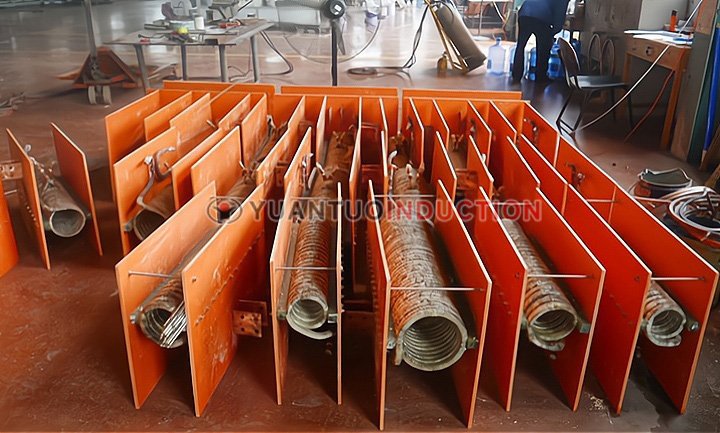
Induction frequency determines how heat is distributed inside the workpiece.
Selecting the proper frequency helps achieve an appropriate balance between heating efficiency and heat penetration.
During equipment design, engineers normally consider:
Rather than selecting a frequency based on one parameter alone.
A continuous induction heat treatment line generally consists of:
The final configuration should always be determined according to the workpiece dimensions, production capacity and heat treatment requirements.
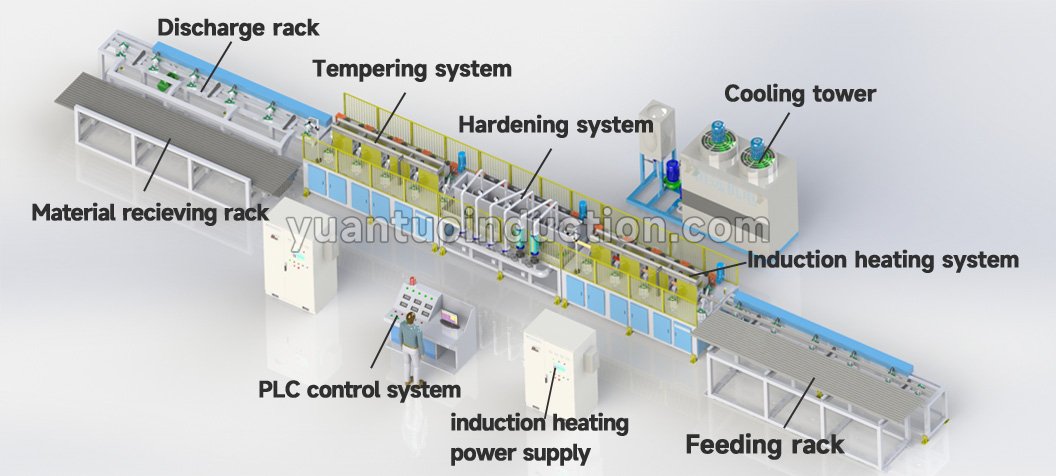
Loading→Induction Heating→Infrared Temperature Measurement→Spray Quenching→Tempering (Optional)→Cooling→Automatic Unloading
Every production project has unique technical requirements.
Steel bar diameter, steel grade, production capacity and required heat treatment process all influence:
For this reason, continuous induction heat treatment lines are typically engineered as customized systems instead of standard models.
A customized solution generally provides better process stability, heating consistency and long-term production efficiency.
Before requesting a quotation, it is recommended to prepare:
✔ Steel bar diameter range
✔ Bar length
✔ Steel grade
✔ Required heat treatment process
✔ Production capacity
✔ Heating temperature
✔ Workshop voltage
✔ Automation requirements
A properly designed production line can cover a certain diameter range. If the range is very wide, engineers usually optimize induction coils and process parameters according to the main production sizes to maintain heating efficiency and product quality.
Different diameters require different heating penetration depths and heating characteristics. Therefore, induction frequency should be selected according to the workpiece dimensions and process requirements rather than using one frequency for all products.
Not necessarily.
Whether multi-stage heating is required depends on the bar diameter, steel grade, target temperature and production speed.
The most important information includes:
These parameters provide the basis for developing a customized engineering solution.
Steel Bar Quenching vs. Quenching and Tempering
How to Choose a Steel Bar Quenching and Tempering Line
If you are planning a new steel bar heat treatment project, preparing information such as workpiece dimensions, steel grade, production capacity and required heat treatment process in advance will help engineers recommend a more suitable induction heating solution.
