
Inquiries for steel bar quenching and tempering lines often begin with one parameter: bar diameter.
Diameter is important, but it is not enough to determine the complete production line configuration.
For example, two manufacturers may both need to process Ø50 mm steel bars. However, if the material grade, bar length, required mechanical properties or hourly capacity are different, the induction heating, quenching, tempering and conveying systems may also require different configurations.
This is why continuous steel bar Q&T lines are typically engineered according to actual production requirements.

Different materials, such as 45 steel, 40Cr and 42CrMo, do not necessarily use the same heat treatment process.
Even when the bar diameter is identical, engineers still need to consider:
Therefore, the same diameter does not mean the same heat treatment process.
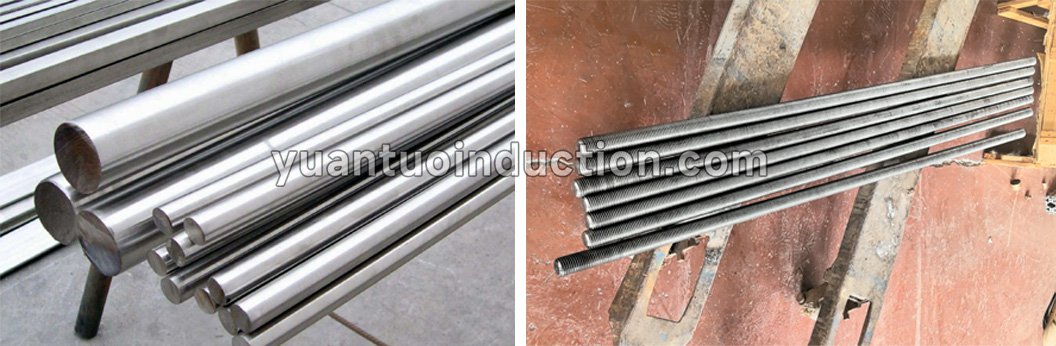
Continuous induction heat treatment is not only about heating.
Steel bar length also affects:
For long steel bars, the design also needs to consider stable guidance and conveying while the material is at high temperature.
Therefore, both diameter and length range should be provided during project evaluation.
Consider the same Ø50 mm steel bar again.
A line designed for a relatively low hourly output and a line designed for continuous high-capacity production will not necessarily use the same configuration.
The complete production rhythm needs to coordinate:
Loading → Conveying → Induction Heating → Quenching → Tempering → Cooling → Unloading
For this reason, required capacity in tons per hour or pieces per hour is an important parameter when designing a customized steel bar Q&T line.
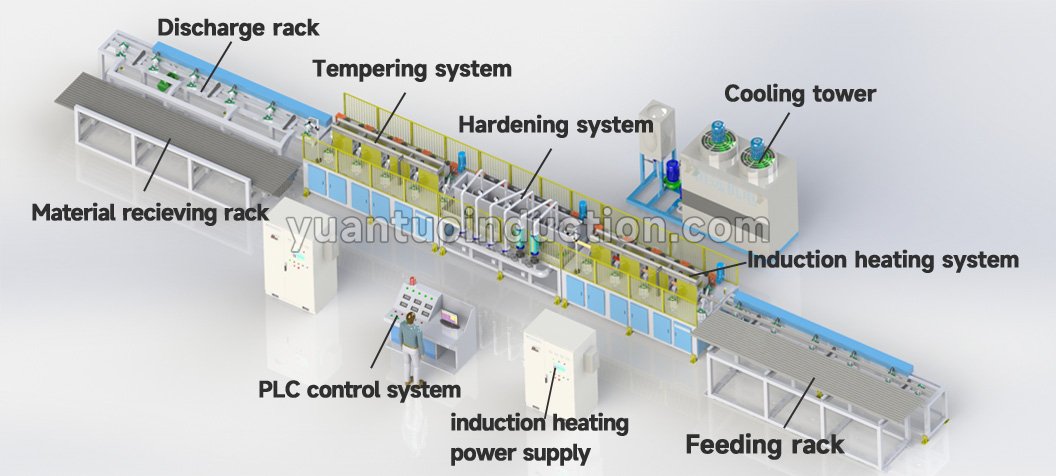
The final objective is not simply to heat the steel bar.
The production line must achieve the required heat treatment performance.
Before designing the solution, it is important to confirm:
Different performance requirements may lead to different heating, quenching and tempering configurations.
For initial engineering evaluation, it is recommended to provide:
Steel bar diameter range + length + material grade + target properties + hourly capacity + existing production conditions.
If several bar sizes need to be processed on one production line, it is also useful to provide:
This information helps engineers evaluate whether different specifications can be processed on one line and how the system should be configured.
Usually not. Material grade, length, heat treatment requirements, target temperature and production capacity also influence the equipment configuration.
In some projects, yes. However, the complete diameter range, materials and production requirements should be evaluated during the design stage. A wider size range may require different heating configurations or product changeover arrangements.
Production capacity affects the speed at which steel bars pass through the line and determines how the heating, quenching, tempering and conveying sections should be matched.
Steel bar diameter is only the starting point for designing a quenching and tempering line.
By evaluating diameter, length, material grade, target properties and production capacity together, engineers can determine a more appropriate configuration for the induction heating, quenching, tempering, conveying and automation systems according to actual production requirements.
WhatsApp:+86 15226757228
Email:yuantuo38@gmail.com
