
| Item | Specification |
|---|---|
| Workpiece | Steel Bars / Round Bars |
| Heat Treatment Diameter | 12–150 mm |
| Forging Heating Diameter | 22–400 mm |
| Heating Method | Medium Frequency Induction Heating |
| Equipment Type | Customized Continuous Production Line |
This continuous induction heating solution is suitable for applications requiring consistent heat treatment quality, including:
Although these products differ in size and material, they all require stable and uniform heating to achieve reliable heat treatment results.
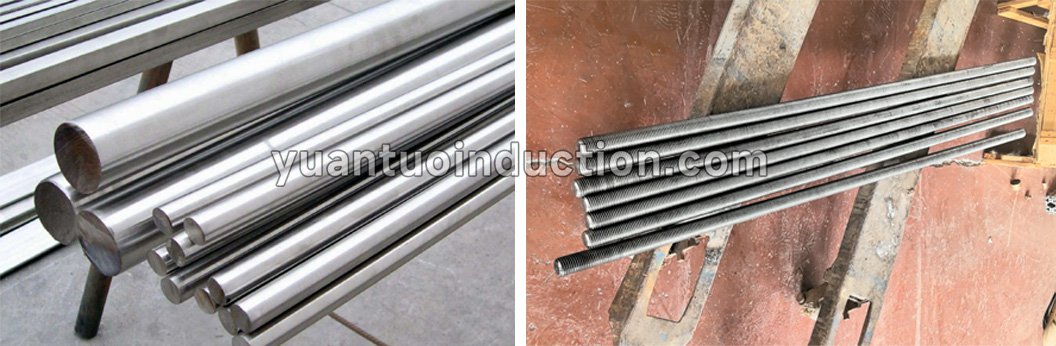
In steel bar heat treatment, reaching the target temperature is only part of the process.
Equally important is ensuring that heat is distributed as uniformly as possible throughout the workpiece.
If different areas of the steel bar are heated unevenly, the subsequent quenching or tempering process may produce inconsistent metallurgical properties.
For continuous induction heating lines, temperature uniformity is therefore one of the key indicators of process stability.
Several factors influence heating consistency during induction heat treatment, including:
Rather than optimizing only one parameter, engineers normally evaluate these factors together to achieve a balanced process.
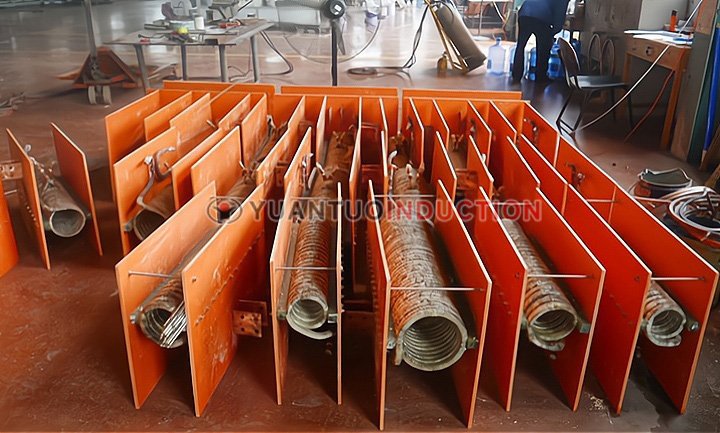
The induction coil is responsible not only for generating heat but also for determining how heat is distributed across the workpiece.
An appropriate coil design is typically developed according to:
Different steel bar sizes often require different coil configurations to achieve stable heating performance.
During continuous production, operating conditions may change over time.
An infrared temperature measurement system continuously monitors the surface temperature of the workpiece and provides real-time feedback to the control system.
When temperature deviations occur, the control system can automatically adjust power output according to the selected process strategy, helping maintain more consistent heating conditions.

A stable induction heating process usually depends on the combination of several engineering measures, including:
In practice, overall process coordination is generally more important than increasing heating power alone.
Automatic Loading → Induction Heating → Infrared Temperature Measurement → PLC Automatic Power Adjustment → Spray Quenching → Tempering (Optional) → Cooling → Automatic Unloading
Several misunderstandings are common during equipment selection and process planning:
❌ Assuming that reaching the target temperature is sufficient without considering temperature uniformity.
❌ Increasing heating power without adjusting conveyor speed.
❌ Ignoring the value of continuous temperature monitoring.
❌ Applying identical process parameters to different workpiece sizes.
Stable heat treatment requires coordinated control of multiple process variables rather than focusing on a single parameter.
When commissioning a continuous induction heating line, engineers typically pay attention to:
Optimizing these factors together usually provides more stable production performance than adjusting individual parameters independently.
Every steel bar heat treatment project has its own production requirements.
Factors such as workpiece dimensions, steel grade, heating temperature and production capacity all influence temperature distribution during induction heating.
For this reason, continuous induction heat treatment lines are generally designed as customized systems to match the specific production process and achieve stable heating performance.
Before requesting a quotation, it is recommended to prepare:
✔ Steel bar dimensions
✔ Steel grade
✔ Required heat treatment process
✔ Target heating temperature
✔ Production capacity
✔ Power supply conditions
✔ Cooling conditions
✔ Automation requirements
Different bar diameters and steel grades have different heating characteristics. Process parameters normally need to be adjusted according to the specific application.
For continuous production lines, infrared temperature monitoring helps improve process stability and product consistency by providing real-time temperature feedback.
Yes.
Uniform heating is one of the important factors contributing to consistent quenching and tempering performance.
Stable production usually depends on coordinated optimization of induction coil design, conveyor speed, power regulation and temperature monitoring.
How Does Induction Heating Frequency Affect Steel Bar Heat Treatment?
How to Reduce Oxidation During Induction Heating
Achieving stable temperature uniformity requires more than selecting the right power supply. It involves coordinating workpiece dimensions, induction coil design, process parameters and production conditions.
If you are planning a continuous steel bar heat treatment project, providing information such as workpiece size, steel grade, production capacity and heat treatment requirements will help engineers develop a customized induction heating solution that better matches your manufacturing process.
