
When steel bars are heated at high temperatures, the surface reacts with oxygen in the surrounding atmosphere.
This reaction may create oxide scale on the steel surface.
The oxidation level is influenced by multiple factors, including:
For continuous induction heating lines, proper process design helps control oxidation during production.
Several parameters influence oxidation behavior:
These factors are interconnected and should be optimized as a complete process rather than adjusted individually.
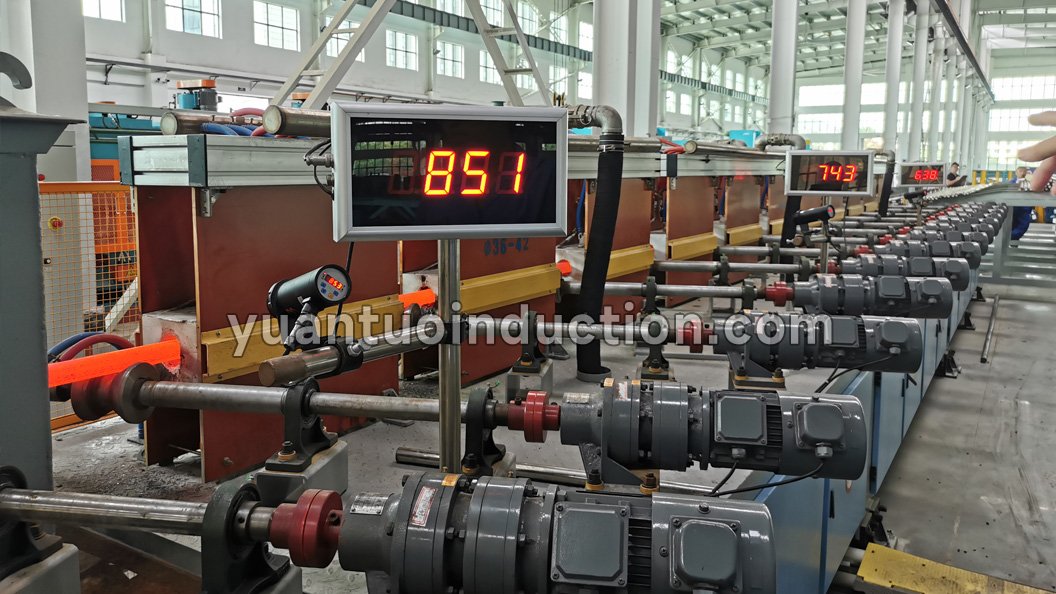
Compared with some traditional heating methods, induction heating has characteristics such as:
Under suitable process conditions, reducing the time that steel remains at high temperature can help control oxidation.
However, the actual result depends on:
Oxidation control in continuous induction heating can be improved through several engineering measures:
A coordinated production process is usually more important than changing only one parameter.
Automatic Loading → Induction Heating → Infrared Temperature Measurement → Spray Quenching (According to Process Requirements) → Tempering (According to Process Requirements) → Cooling → Automatic Unloading
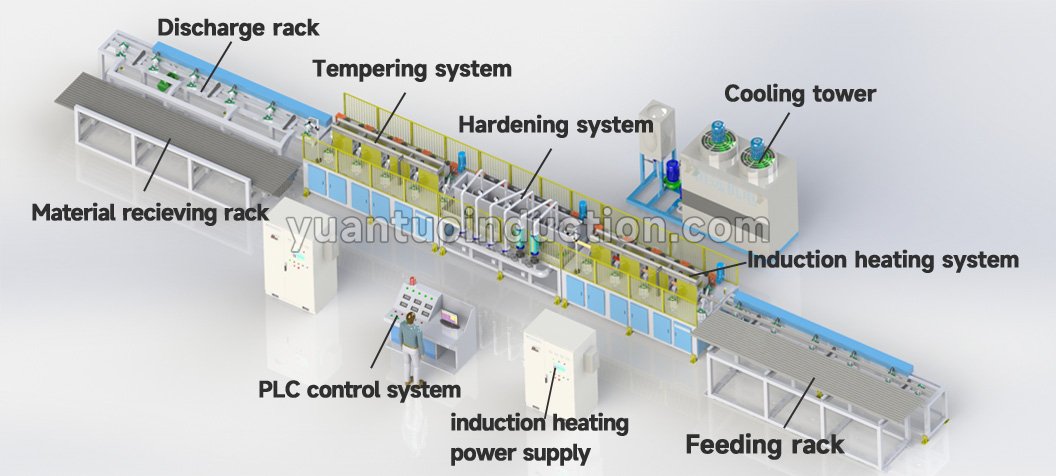
Several common misunderstandings should be avoided:
❌ Increasing heating temperature unnecessarily to improve production speed.
❌ Adjusting only power output while ignoring production rhythm.
❌ Applying identical parameters to different steel grades.
❌ Allowing excessive residence time in high-temperature areas.
Oxidation control requires coordination between temperature, heating time, conveying speed and material characteristics.
When optimizing induction heating processes, engineers usually evaluate:
A balanced process design helps improve production stability and maintain consistent surface quality.
Different steel bars have different requirements due to variations in:
These factors influence heating parameters, induction coil design and production rhythm.
Therefore, continuous induction heating lines are normally developed as customized solutions based on actual operating conditions.
A properly matched system helps balance production efficiency and surface quality requirements.
Before requesting a quotation, prepare:
✔ Workpiece dimensions
✔ Steel grade
✔ Heat treatment process
✔ Required heating temperature
✔ Production capacity
✔ Power supply conditions
✔ Automation requirements
No.
Oxidation behavior depends on many factors, including material characteristics, heating temperature and exposure time.
A properly designed process can help reduce and control oxidation, but the actual result depends on the specific application.
Different steel compositions have different high-temperature oxidation characteristics, so process parameters may need to be adjusted according to the material.
Yes.
Conveyor speed determines how long the steel bar remains in the high-temperature heating zone, making it an important factor affecting oxidation.
Surface quality can be improved through coordinated optimization of:
How to Improve Temperature Uniformity in Continuous Induction Heating
How Conveyor Speed Affects Continuous Steel Bar Heat Treatment
Controlling oxidation during induction heating requires more than adjusting heating power. Workpiece dimensions, material grade, heating temperature, production speed and process requirements should be evaluated together.
Providing complete technical information helps engineers develop a more suitable continuous induction heating solution for stable production and consistent heat treatment quality.
